Real-time location tracking is critical for transportation and logistics companies globally. This promotes the smooth movement of goods on trucks and ships. Accurate tracking lets fleet managers find faster routes and avoid delays, leading to happier customers. Digital signage for transportation improves communication between fleet managers, drivers, and dispatch teams.
The signage displays updated information, which boosts logistics efficiency, saves time, and streamlines transportation workflows. Location data boosts accuracy, reduces fuel costs, allowing teams to adopt a smart work approach. The data improves transportation safety on seas, roads, and railways, leading to reliable logistics.
Using digital signage for logistics and real-time insights to adjust routes
Conditions on the road and sea may change after trucks or ships depart towards destinations. Trucks may experience traffic congestion, bad weather, or accidents. These experiences require smart decisions to save, fuel, and deliver products on time. Real time insights and digital signage for logistics help display information about the current situation on roads.
Location data pinpoints road or sea sections that might cause delays, leading to spoilt goods and significant delays. Fleet managers send this data to drivers and dispatch teams, allowing them to make decisions fast. They may change the routes or park at a safe place to save on fuel. This data allows teams to adopt speed, improve services, and manage a large fleet from one place.
Enhanced coordination within the supply chain environment
An effective supply chain ensures products move quickly to reach customers at the perfect time. The processes involve proactive planning, lowering costs, and boosting efficiency within the chain. Perfect coordination in the chain is necessary for quick response to issues, reliability, and transparency. This approach benefits transportation logistics companies in many ways.
Location data and digital signage for logistics support the supply chain by ensuring every stakeholder works as a team.
This information ensures drivers, fleet managers, and warehouse teams are actively engaged in the workflow processes.
Warehouse teams prepare deliveries in advance, allowing drivers to save waiting time.
Managers alert customers minutes before shipment arrival, allowing them to prepare offloading space.
Location data eliminates frustration, long waiting times, missed routes, and delivery delays.
Streamlining workflows at terminals and loading zones with digital signage for logistics
Bid data in retail sector is necessary for inventory management, decision making, reducing waste, and enhancing efficiency. This data is useful in creating and maintaining effective digital signage for logistics in loading zones and terminals.
Organizations place large screens to show directions, updated data, and delivery schedules. Work teams look at this information and take necessary steps in real time. Work teams no longer waste time waiting for instructions. Digital signage empowers today’s transportation logistics in a big way. Employees rarely make mistakes and goods reach their destinations on time.
Learning from route patterns and using them as planning tools
Delivery vehicles use roads, highways, and streets daily, ensuring goods reach customers on time. Location data platforms collect and store information, allowing fleet teams to view route patterns followed by drivers. The data informs the team about average waiting times, economical routes, and vehicle maintenance needs.
Some drivers may wait for a long time at a specific point on the road. The team uses this data to change routes for the rest of the team. The information lets them see common causes for delays and change the plan to avoid the challenges. Changing route patterns into planning tools boosts service quality and saves money.
Environmental protection and fuel use reduction
Location data allow logistics companies to identify fuel-economical routes, which saves money and protects the environment from pollution. Trucks nowadays can have digital signage for transportation installed on dashboards. This lets managers display location data, allowing drivers to avoid missing their next turns, avoid congested and closed roads.
Drivers use smart route apps that allow them to follow the safest and fastest routes. This helps the company achieve its pollution reduction goals, arrive at destinations quickly, and save fuel. Real-time location information is becoming a valued asset in the transportation and logistics sector.
The future of location data in streamlining transportation logistics
Technology is continuously improving, making transportation logistics smarter and more effective. Location data will be crucial in the future, allowing drivers, ship captains, and fleet managers to use smart GPS tools and sensors. This will allow them to follow vehicles in real time and direct them on the safest and best routes.
Customers and transporters will know the exact shipment arrival time, leading to higher satisfaction rates. Future technologies will connect warehouses with multiple management and supply chain platforms. This will limit transportation costs, losses and improve data accuracy.
Conclusion
Transportation logistics no longer rely on shipping products from one point to the next but on working smarter to save fuel and the environment. Trucking companies use smart technology to avoid closed roads, bad weather, and traffic. Digital signage for transportation and location data improves coordination, keeping teams informed, updated. This reduces delays, improves communication, and leads to happier customers.
Digital platforms are increasingly tapping into user geolocation data to shape engagement and drive conversions. From mobile apps that ping you with offers when you’re near a store, to social feeds showing hyperlocal ads, location-based marketing (LBM) is becoming central to how companies connect with consumers. Marketers love it – 80% say location-based campaigns generate higher response rates and better user engagement than traditional outreach.
Consumers are on board too: 72% of users actually want ads tailored to their local area. Small wonder that brands from coffee chains to tech giants are racing to leverage our GPS coordinates. The question is: does tying marketing to a user’s physical location really boost digital engagement in a meaningful way? Let’s explore how LBM is playing out across industries, from online gaming to retail, and what it means for the future of platform engagement.
How Online Gaming Reveals the Power of Geo-Triggered Engagement
One unlikely space showcasing the impact of geo-targeted marketing is online gaming, especially quick, solo games like online roulette. Unlike multiplayer games (think online poker) that depend on others being available, roulette is a fast-paced solo experience. This makes it an ideal testbed for location-based triggers: a well-timed push notification tied to where a player is or what they’re doing can instantly prompt a gaming session. For example, an online casino app might detect a user entering a new city or arriving home at 8 PM and send a “spin the wheel now” offer localized to that context. Because roulette requires no coordination with other players, the user can act on the nudge immediately. In contrast, a poker app might notify you, but your engagement still hinges on enough people joining a table (a more hit-or-miss proposition).
Gaming companies are starting to notice these dynamics. In fact, marketers found that adding location targeting to mobile notifications dramatically increased player activity – a few times higher engagement compared to standard, non-geotargeted alerts. These geo-triggered messages can tie into local events or incentives: imagine getting a free roulette bet when you’re near a real casino, or a special bonus if you log in from a state fair or sports stadium. This is a powerful showcase of how geo-data can drive digital platform usage in real time.
Case Study: Big Tech Bets on Location: The Meta (Facebook) Example
Location-based marketing isn’t just for retail or gaming, as major tech companies also are weaving geo-targeting into their platforms to boost user engagement and advertiser ROI. A prime example is Meta (formerly Facebook). Meta’s advertising tools let brands deliver ultra-localized content to users on Facebook and Instagram, and it has proven enormously effective. Sportswear giant Nike leveraged Meta’s geotargeting to send location-based notifications about local sports events, new store openings, and city-specific promotions. This approach of reaching people where they are, significantly drove foot traffic and strengthened Nike’s local brand presence. Essentially, by marrying online ads with on-the-ground context, Nike saw more nearby customers engage with the brand in person.
Meta has rolled out features like “Store Visits” ad objectives that explicitly aim to convert online impressions into offline engagement. In one trial, Starbucks partnered with a mobile ad network to target users in proximity to its cafés, using dynamic creative that showed distance to the nearest store. The result was a 60%+ lift in store visits attributed to the location-targeted campaign. In other words, adding the place dimension – knowing a user is, say, within a few blocks of a Starbucks – doubled the likelihood they’d walk in and buy something.
Meta enables these kinds of campaigns at enormous scale for advertisers. By 2025, nearly every major brand page on Facebook is using some form of location targeting, whether it’s a local coupon for users in a specific city or push alerts from the Facebook app about events “happening near you.” The takeaway from the tech world’s embrace of LBM is clear: combining personalization with real-world context pays off. People respond to content that recognizes where they are and what might interest them there, so much so that even digital-native companies are building strategies around location data as the key to deeper engagement.
Personalization and Privacy: Balancing the Promise of LBM
Personalization and Privacy: Balancing the Promise of LBM
If location is the new linchpin of engagement, it comes with a balancing act between personalization and privacy. On one hand, incorporating location signals allows for remarkably relevant, timely experiences. Marketers across industries report that using location data helps them better understand audiences and create more successful campaigns; as many as 84% say location-based efforts have grown their customer base, and 84% also report increased customer engagement from LBM. Whether it’s a travel app suggesting attractions when you land in a new city, or a retail app reminding you of unspent loyalty points when you’re near a store, these services make digital content feel personally tailored and useful. In fact, users often welcome it: in a survey of 1,000 smartphone owners, 42% said they would use an app more if its push notifications were triggered by their current location. Done right, location-based messaging doesn’t creep out users but pulls them in.
For brands operating across multiple markets, using localized messaging supported by services like Milengo’s marketing translation services helps ensure that location-based campaigns remain clear, accurate, and culturally appropriate.
That same expectation of relevance extends to language. For global brands, delivering content in the right location and in the right language is essential. That’s where MachineTranslation.com, the world’s most accurate AI translator, plays an important role. Developed by Tomedes—a global leader in translation and localization—MachineTranslation.com allows platforms to automatically deliver multilingual content in over 270 languages. Its AI Translation Agent not only refines tone and terminology based on user input but also remembers prior preferences for registered users, making each interaction smarter over time. Whether you’re sending a location-triggered notification in Paris or launching a campaign in Bangkok, this AI translator tool ensures your message lands with clarity, cultural fit, and brand consistency.
And indeed, when executed thoughtfully, location-based marketing exemplifies the best of personalized digital engagement, delivering helpful, context-aware content at just the right moment. From impulsive roulette games triggered by geolocation, to Nike connecting with sneakerheads at the city-block level, to fast-food chains like Burger King using geofences to lure customers from a competitor’s parking lot (the infamous “Whopper Detour” campaign drove 1.5 million app downloads by offering 1¢ burgers to users near McDonald’s ), LBM is reshaping how brands and platforms interact with us.
As more industries adopt these tactics with 72% of companies now deeming LBM “vital” to their business, we can expect our apps and devices to become ever more attuned to where we are. The future of digital platform engagement may well belong to those who master that location-context connection, blending the digital and physical into one seamless customer experience.
Businesses are constantly seeking ways to enhance customer engagement in a data-driven world. Location data is revolutionizing customer engagement by offering deeper insights into customer behavior, preferences, and needs. This technology allows companies to provide personalized services, optimize operations, and improve overall satisfaction. Industries leverage real-time location intelligence from retail to transportation to enhance customer interactions.
For moving companies, location data has opened up new opportunities to streamline operations, offer more precise services, and boost customer loyalty. So, let’s explore how businesses are using location data to transform their engagement strategies and deliver better, more tailored experiences across various sectors.
Why Location Data is Crucial in Modern Customer Engagement
Businesses today rely heavily on data-driven decisions to stay ahead. Location data offers a unique advantage by providing real-time insights into customer behavior, movement patterns, and preferences. Industries like retail and hospitality use geospatial data to engage with customers at the right place and time, offering personalized services based on their location.
This level of precision allows businesses to tailor their interactions, boosting customer satisfaction and loyalty. Whether sending targeted offers or optimizing service delivery, location data helps companies create meaningful, timely connections, transforming how businesses approach customer engagement.
Transforming Moving Companies with Real-Time Location Intelligence
Real-time location intelligence is transforming how moving companies operate and engage with customers. By tracking vehicles and assets in real-time, companies can optimize routes, reduce delays, and provide more accurate arrival estimates. This improves operational efficiency and enhances communication with customers, offering them transparency throughout the moving process.
Location data allows moving companies to personalize services by adjusting based on the customer’s geographical area, such as offering tailored solutions for urban vs. rural moves. With the ability to respond dynamically to changing conditions, moving companies can deliver smoother, more reliable services, ultimately boosting customer satisfaction and trust.
Enhancing Personalized Services with Location Data
Personalized services are key to creating loyal, satisfied customers; location data is pivotal in making this possible. Industries like food delivery and e-commerce use location data to offer tailored experiences. For instance, they can recommend nearby restaurants or adjust delivery times based on traffic. Moving companies can also leverage this data to provide customized offers or follow-ups, like discounts for customers within a certain radius.
With real-time insights, businesses can adjust services dynamically, ensuring they stay relevant to the customer’s needs and location. This way, location data is revolutionizing customer engagement across industries and enhances the overall customer experience.
Optimizing Lead Management with Location Data
Location data isn’t just about enhancing customer interactions—it’s also a powerful tool for optimizing lead management. For moving companies looking to streamline their customer acquisition processes, platforms like this offer tools that help manage leads with ease by utilizing location insights to identify and prioritize high-value leads, ensuring that no opportunity is missed.
By analyzing geographical data, companies can focus their efforts on regions with the highest potential, improving the chances of conversion. CRM systems integrated with location data also allow businesses to track and engage with leads based on proximity, enabling more personalized and timely outreach. This location-based approach makes lead management more efficient and drives higher conversion rates.
Streamlining Operations for Efficiency and Cost Reduction
Location data is transforming how businesses, including moving companies, optimize their operations for maximum efficiency. By utilizing real-time location intelligence, companies can track their assets and personnel, allowing for route optimization that reduces fuel costs, delivery times, and unnecessary delays. This data-driven approach helps businesses allocate resources more effectively, ensuring that vehicles are on schedule and where they need to be.
Moving companies also benefit from real-time updates, enabling them to make quick adjustments when faced with traffic or weather disruptions. This level of operational optimization not only cuts costs but also improves overall service quality, leading to better customer experiences and long-term savings.
CRM Systems: Tracking Customer Journeys with Location Data
Customer Relationship Management (CRM) systems are evolving with the integration of location data, transforming how businesses track and manage customer journeys. A great example is how moving companies increasingly turn to platforms like MoversTech CRM to integrate location data into customer management systems. This allows them to personalize customer engagement by tracking movements and tailoring services to individual needs, ultimately improving the customer experience.
By using location-aware CRM systems, moving companies can optimize lead management, track key touchpoints, and offer more personalized follow-ups. These systems also streamline processes by automating updates and providing real-time insights, helping businesses improve engagement strategies and deliver more relevant, timely customer service.
Targeted Marketing Strategies Based on Location Data
Location data enables businesses to create highly targeted marketing campaigns that reach customers at the right place and time. With data-driven marketing, companies can tailor promotions, services, and ads based on a customer’s current location, maximizing relevance and engagement. For instance, moving companies can run geo-targeted ads in specific cities or regions to attract customers needing their services.
Using strategies like geofencing and beacons, businesses can send location-specific offers to potential customers, increasing the likelihood of conversion. Location data revolutionizes customer engagement by enabling enterprises to deliver personalized marketing messages that resonate with local audiences, driving higher engagement and boosting sales.
Caption: Use location data to enhance customer engagement and satisfaction
Alt. tag: a woman using her phone and smiling
Improving Customer Satisfaction Through Real-Time Updates
Customers value transparency, and real-time updates made possible by location data enhance this significantly. Businesses can now provide precise updates on service timelines, such as estimated delivery or arrival times, keeping customers informed and reducing uncertainty. Real-time tracking of vehicles and crew for moving companies builds trust and eases customer anxiety during stressful moving processes.
This transparency lets customers plan better and feel in control, improving their overall experience. Companies can strengthen customer relationships by delivering timely updates and proactive communication, enhancing satisfaction and loyalty. Location data, thus, plays a crucial role in creating smoother, more reliable customer interactions.
The Ongoing Impact of Location Data on Customer Engagement
Location data is revolutionizing customer engagement across industries. It provides businesses with tools to offer personalized services, optimize operations, and enhance satisfaction. Moving companies, in particular, can leverage real-time location intelligence to improve service delivery and customer trust. As location-based technologies evolve, businesses must embrace these advancements to stay competitive and deliver superior customer experiences.
Although its parent company, Alphabet, might tell its mission is “to make the world around you universally accessible and useful”, Google is very much the information arm of that goal.
Google needs information to achieve its goal, and so it hoovers up as much as it can from wherever it can, whether that’s through implicitly permitted activities like scraping websites, review sites and social media sites for information it can pass on to its users, or through more explicitly permitted activities like requesting and using your GPS location on your device.
It’s the latter that I’d like to talk about today: specifically how this location data impacts and informs what you see when you perform a Google search. As we’ll discover, very little of the search experience is untouched by location data, and in the case of local SEO, it’s an integral part of the search algorithm. Other methods to make your SEO better include SEO split testing, quality content, proper keyword research, quality link building, getting an online SEO certification etc.
Why does Google need to use location data?
To understand why Google uses location data and how Google scraper works, we first need to look at the history of local search. It’s sometimes hard to believe, but there once was a time when local search functioned in the same way as organic search. Namely, you’d need to type the search term and location to see businesses near you, e.g. “pizzas brooklyn new york”.
Then, with the introduction of location data gathered via GPS, it was easier to find local businesses by searching “pizzas near me”. Fast-forward a bit further, and Google is now so in tune with the intent of your search that it can tell merely from a search term whether the searcher is looking for something local. In fact, 46% of all Google searches are estimated to have a ‘local intent’.
The Local Pack and Google My Business
These days, you can simply type “pizza” with location data enabled, and you’ll be shown pizza places near you. These are presented in what’s called the ‘local pack’, a selection of three businesses that Google believes fit with the search intent, are local enough, and have a good enough standing to rank.
There are many individual local ranking factors that play a part in how well a business is likely to rank here, and these change slightly every year, but it shouldn’t come as a surprise that the #1 factor comes down to the use of a Google product. It’s called Google My Business, and it’s the single most important tool in any local SEO’s armoury.
The information visible in every listing you see in the local pack all comes from these business’ Google My Business profile, which is made up of a mixture of objective information submitted by the business (e.g. opening times, category, description), subjective information submitted by consumers (e.g. Google Reviews, Google Q&A) and information scraped from the business website by Google (e.g. Services, Menu – though these can be overwritten manually). One can also submit the URL to Google console manually to have their website indexed.
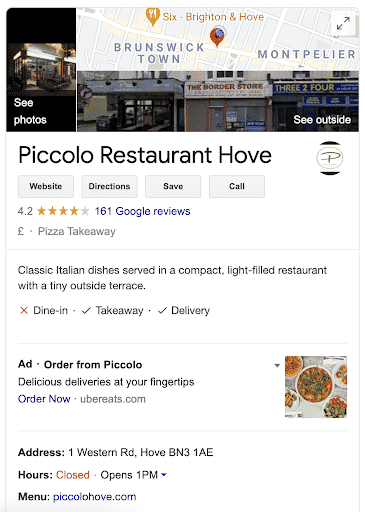
Here’s an example of a Google My Business profile as it appears in the Knowledge Panel in a branded search for this business:
You’ll see that one of the fields here is ‘Address’. This is one of the pieces of information that you submit when setting your business address. It’s not automatically gathered by Google based on information from directory listings or the Post Office. However, it’s worth noting that consistency across all these is key to building trust with Google and consumers.
Google uses your business address location data not just to pin you on Google Maps and give you the privilege of a Google My Business listing but to ensure you enjoy relevant placement in local search results for local searches within a reasonable proximity of your business.
What that proximity is very much depends on a few factors, but the saturation of your business type and the population density in your local area naturally have an impact.
For example, in the example above, a search for a popular term like “pizza” resulted in an incredibly tight area being presented on the map. That’s how far Google needed to go to find three relevant businesses. However, plug in a niche business type like “taxidermist” and Google has to go as wide as the whole of the South-east of England to present the results.
This is a very basic overview of how location data is used to personalise search results for business types, but what happens when the search isn’t clearly for a business but could still have local intent?
Localised organic search
“Localised organic” search results are those in which, as the name suggests, organic search results have been put through a local filter based on the search location.
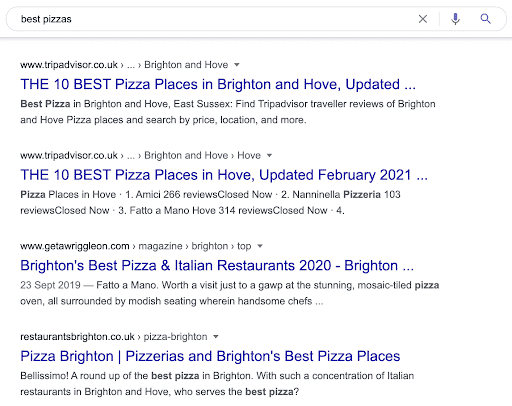
For example, if I search “best pizzas”, one could infer from the unspecific nature of the search that I’m simply looking for a list of the most popular pizza types, or perhaps best pizza places in the world. Not Google, though.
Based on its collection of millions of search terms, results, and data on what links clicked after which searches, Google thinks that what I really mean is “best pizza near me”.
It’s worth noting that the above appears below a local pack similar to the one shared earlier. This tells you just how confident Google is that what I want to see is a list of the best pizzas near me, based on my search location.
Google Ads
Another key area in which Google uses location data to inform what it presents in search results is Google Ads.
When you set up a Google Ads campaign, you can determine whether you want your ads to be seen by an audience searching from a specific location. This might be useful in the example above, if we wanted to appear in search for people in Brighton looking for pizzas.
Obviously, because Google Ads is a paid-for service (and one of Google’s key revenue streams, to boot), there are extensive, and evolving, options for advertisers to use search location to increase targeting of their ads. Search Engine Land has a great rundown of what’s changed with Google Ads and location recently.
How does Google collect location data?
The sharing and usage of location data have long been entwined in arguments and controversy around privacy on the web. There have been countless suits, countersuits, and pieces of legislation that can impact what private information can be requested and used (most notably the GDPR back in 2018 and, more recently, the California Consumer Privacy Act), but as far as I’m aware the use of location data alone hasn’t been central to any.
As it’s not a piece of personally-identifiable information alone, your location data tends to be up for grabs, but critically, only when you agree to share it. This can be done at a device level (for example, in iPhone settings) or app level (in your Google Account), but there’s one instance, as we’ll see below, in which you cannot prevent Google from knowing a little about where you are.
Let’s look at some of the ways Google determines your search location.
Device location and GPS
Provided you’ve set up access to this information on your device, Google can see where it is (and if it’s a mobile device, exactly where you are, at least if your mobile-carrying habits are like mine). For local searches, this is particularly relevant to smartphones, as we’re much more likely to perform local searches when we’re out and about, looking for a cafe in a town we’re visiting, or looking up an address for directions.
Most smartphones are equipped with a GPS chip that communicates with satellites to allow you (and others) to pinpoint your location to a remarkably accurate degree. If your device location was used to help get your Google search results, the location information at the bottom of the search results page will say “From your device”.
Location History
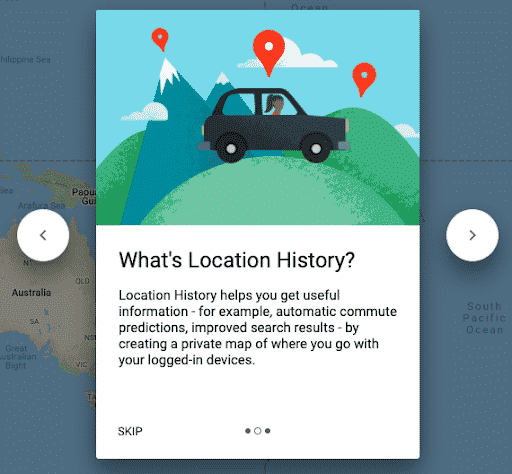
Log in to your Google Account, head to ‘Location History’ in ‘Activity Controls’, and you can see a timeline of exactly where you’ve been telling Google you are and when you were doing so. It even goes as far as telling you how Google uses this information. On top of being a fun feature, you can actually utilize your Google Timeline to transform it into an IRS-Proof mileage log to save you $1000’s for your business. Check out how MileageWise can help you maximize your business tax deductions.
I actually have to applaud Google’s brazen way of turning what could be considered by some as creepy tracking into a fun feature. (For what it’s worth, I would happily share an example of my own location timeline if I weren’t writing this in a pandemic and looking at a fairly non-existent variety of location data points.)
If you’re a big Google Maps user, you may have set your Home and Work addresses in your Google Account. This makes it a lot faster to determine directions and route times in Google Maps.
However, what you might not know is that, even without knowing your precise location via GPS, Google can use this information to make assumptions about where you’re likely to be searching from. For example, if Google knows, through past location data, that you work 9-5 in an office in town and generally spend the evenings at home, it can tailor search results to those places and timelines, allowing you to search for a lunch spot near you at lunchtime without needing to explicitly tell Google where you are.
If the location of your labeled places was used to help get your search results, the location information at the bottom of the search results page will say “From your places (Home) or (Work)”.
“You can’t prevent apps or websites that you visit, including Google, from getting the IP address of your device because the Internet does not work without it. This means all apps and websites that you visit can usually infer some information about your location.” – Google.
You might think that an IP address is only applied when using a wi-fi connection rather than just on 3G, 4G, or 5G, but the messy truth of it is that IP relates to these services, too.
The location data that systems like Google can glean from your IP is much, much less accurate than GPS, covering a broad area rather than your exact location in the world. Still, it’s interesting to note that the very act of using the internet comes with a signed contract to give up some of your location data.
If your IP address was used to estimate your current general area for your Google search, the location information at the bottom of the search results page will say “From your internet address”.
Business location data
Completely different to dynamic location tracking is the act of storing a business’ address in Google My Business. As mentioned above, this is critical to allow Google searchers to know how to visit your business location. Still, it’s worth noting that even service businesses without a physical location can get Google My Business listings and appear in local search results based on the submitted service area.
Google collects business information through a submission and verification process, but when it comes to local landmarks, much of this is user-created or a matter of public record. For example, no-one ever needed to tell Google where Buckingham Palace is.
Google location data types
There are a few different codes and URLs that local search tracking tools use to define search location and review content. These are mostly defined by Google and are of particular importance to a business location.
Ludocid
The Ludocid, sometimes referred to as the ‘CID’, is a unique ID that Google assigns to a specific business location to identify it within its systems. The Ludocid can be used within Google search URLs to return the Knowledge Panel for that specific business. It can also be used within Google Maps to view a specific business.
Place ID
The Place ID is another unique ID that Google uses to identify a specific business within its systems. There are two common uses of the Place ID. The first is in the Google Places API; passing this ID to Google can return extensive information about a business, including its name, address, website URL, opening hours, etc. For example, if your website uses WordPress as a CMS, you can add your Google account to WordPress. This is true if you use a WordPress website builder, like Elementor, as well. Additionally, make sure to use the best-managed WordPress hosting so that your website gets found more easily.
The second use is in constructing a Google search URL to trigger a page that displays all the reviews for a business, or the page where users can write a new review for a business. When Google sees these IDs in a URL, it automatically converts them to a different URL that combines the Ludocid with the FID.
FID
The FID is a unique ID that relates to reviews that Google holds about a specific business. The FID has fewer practical uses than the Ludocid and the Place ID, as it’s primarily used in combination with the Place ID to generate a ‘write reviews’ or ‘read reviews’ URL.
If you know the Place ID, then Google converts this to the FID for you, so you’re unlikely to use the FID directly. It’s easier to create URLs to read or write reviews using the Place ID, but we thought we’d add it here in case it’s of use.
Conclusion
As you’ve seen above, location data is integral to the evolving search experience. We might not be out and about right now as much as we’d like to be, but when lockdowns are lifted, and we roam the streets once more, where we are and what we search for will once again combine to deliver a streamlined, almost invisible personalised search experience that we barely even think about.
Google has already used location data in a creative way to show how little the world is moving due to Covid-19 in its Mobility Report. What Google will do with an explosion of movement, post-pandemic, remains to be seen.
Author Bio
Jamie Pitman has worked in digital marketing for over a decade and is currently Head of Content at local SEO tool provider BrightLocal. He specializes in local marketing and the many factors that affect local search performance, from Google My Business and consumer reviews to branding, content marketing, and beyond.
The sports betting industry is experiencing a transformative shift due to real-time location data. This technology enhances the accuracy of odds, personalizes user experiences, and fuels engagement through innovative betting formats. By exploring how real-time data influences betting behavior, we can better understand its implications for bettors and sportsbooks alike.
1. Enhanced Odds Calculation
One of the most significant impacts of real-time location data is its role in enhancing odds calculation. Traditionally, odds were updated periodically, leading to potential mismatches between market conditions and sportsbook offerings. Real-time data now enables sportsbooks to provide dynamic odds that reflect ongoing events.
For example, the real-time updates on player form, injuries, and even crowd behavior make it possible for sportsbooks to change the price quickly. In this case, odds can also be recalculated almost instantly, given that the position of the injured player was important contributing to the team’s performance. Such responsiveness is paramount for helping the sportsbooks stay relevant while at the same time avoiding more risk of enrichment. Bookmakers, in turn, get the odds that are closer to real-life conditions, which helps to ensure fair betting to the bettors.
2. Growth of In-Play Betting
Getting real-time location information has almost pushed into play betting, where a user can make a bet while the game is ongoing. Thus, in-play betting is dynamic, unlike pre-match betting, which offers simple bets such as the team to score the first goal, etc.
This betting format particularly appeals to younger audiences, especially those using online casino bangladesh platforms, who are accustomed to instant gratification. The immediacy of in-play betting fosters continuous engagement throughout a match. Bettors remain active, making decisions in real-time, which increases the excitement of the betting experience. For sportsbooks, this extended engagement means more wagering opportunities and higher revenue potential.
3. Micro-Betting Opportunities
New real-time data has also propelled micro-betting, which means betting on the instantaneous chances of particular occurrences within short periods. In contrast with conventional bets, which cover the whole game, micro-betting enables users to bet on discrete events, such as the outcome of the next play in a football game.
Micro-betting is common with volatile games that can turn with every passing seconds or even minutes. Such kind of betting continues to make the users participate in an active manner, especially at short time lapses that have very high stakes. In the same nicely bake, micro-betting offers sport books the probability to achieve several goals, including attracting a bigger group of individuals and producing more income. Even for those punters who may not be so interested in the result of a particular match, there are always these short-term betting possibilities.
4. Behavioral Insights and Predictive Analytics
Real-time geolocation opportunities, further added to advanced big data, give sportsbooks better understanding of bettor activity. Specifically, in betting, sportsbooks are able to watch user activity to determine their response to specific odds or events which occur during the game.
Such predictions help sportsbooks decide which promotions, bonuses, and other special offers should target which bettors. For instance, if a player consistently bets on particular occurrences during a live-streaming event, sports betting platforms can offer similar choices to promote compliance. Moreover, sportsbooks can use this data to manage risk, identifying trends that may not be immediately apparent. This proactive approach helps sportsbooks maintain profitability while enhancing user satisfaction.
5. Improving User Engagement
Real-time location data plays a vital role in enhancing user engagement. Modern betting platforms offer live visualizations and data-driven updates that immerse bettors in the action. Instead of relying on static information, users can now see live game events and track how those moments influence betting odds.
This interactive approach builds trust and transparency between sportsbooks and bettors. Users feel more connected to the betting process, and the availability of real-time updates reduces the perception of unfairness. In addition, the interactive experience encourages users to stay engaged throughout the match, resulting in longer betting sessions and increased wager volume.
Conclusion
The integration of real-time location data into sports betting has had a profound impact. It influences both sportsbooks and bettors. Enhanced odds’ calculation, the growth of in-play betting, micro-betting opportunities, behavioural insights, and improved user engagement all contribute to a more dynamic and personalized betting experience.
For sportsbooks, the ability to offer real-time odds and targeted promotions increases revenue potential and operational efficiency. Bettors, on the other hand, benefit from a fairer, more immersive experience that adapts to real-time game conditions. As technology continues to evolve, the sports betting industry is poised to see even greater personalization and innovation, ensuring sustained growth and heightened user satisfaction.
Big data technologies have changed how we use and analyze vast amounts of data. They’ve paved the way for new solutions. These include analytics streams that are automated and efficient. They improve operations. AI and machine learning can analyze vast data streams at superhuman speeds. They unlock a trove of insights. These tools are vital for industries like logistics and entertainment. For example, https://www.playamo.com uses data to personalize users’ experiences.
New forms of information and customer profiles are now possible. They can be segmented and categorized by age, location, and engagement levels. It’s now possible to track and measure how interested or engaged your audience truly are.
But, for business, especially small to medium firms, location data is very useful.
Why Location Intelligence Matters
Data sets are very valuable and full of potential. There’s no denying it. With the right info, you can know your customers’ wants. You can also gauge your business and products. This will help you make better, more predictive decisions.
Crucial to truly understanding context, yet, is the idea of “where” or “when” a series of events comes to pass. Most business intelligence systems let you see a customer’s purchases. You can see details like buy prices, timestamps, and payment methods. But, like most businesses, it’s important to know where that buy was made — the store — and how they paid. Did the customer visit a local store? Did the customer make the buy while traveling, either out of town or abroad? Did they make the buy online?
This information can also add depth to the data you’ve already collected. You see, visualization is needed to understand large data sets. This process is often referred to as “turning your business data into maps.” But, this is only possible with location info on data streams or datasets. Location intelligence links data to specific geographic locations, usually marked by coordinates.
Once you have a location attached, you can present or view the data in new, more revealing ways. This explains why location data is vital. It helps you understand regions and their effects on your business.
Location intelligence will improve marketing, management, and support teams. It will also help supply chain and logistics teams.
Where Does AI Fit In?
AI and machine learning platforms can analyze huge data sets. They can do this quickly and accurately. These technologies are promising. But, where does the “learning” in machine learning come from? They are improving over time as they ingest more data. They are already very accurate and useful. They improve with each use of the technology.
It’s why platforms like IBM’s Watson are not improving. They’re being used for new, innovative things outside their original purpose. A data analysis system can now create film trailers, play games, and aid medical research.
In location intelligence, AI and big data are used to build advanced models. They will have unmatched accuracy. These algorithms (or frameworks, if you will) can then be used to take action or deploy a solution.
Imagine using large data sets in business. You could know when, where, and how to maximize revenue and success. To make this less abstract, let’s look at a real-world example.
It’s hurricane season. On the East Coast, many are stocking up and preparing their homes and families. Retailers and businesses can use this to deliver the right products. It will increase supply to meet demand.
But, imagine knowing how climate, weather, and human behavior affect business. With access to current and historical geographical data, businesses can find insights. They can use them in today’s dynamic market. For instance, a business could predict the exact demand for a product. It could know where and when it would peak. It could also see how these factors would affect production and distribution. It would affect scaling decisions, too. This foresight lets companies be proactive, not reactive. It ensures they run efficiently and waste little.
Moreover, the true power of such algorithms lies in their adaptability and reusability. A validated algorithm is a lasting asset. It provides accurate insights. It can be reused to tackle similar future challenges. It can also be adapted for very different scenarios or market events. It boosts efficiency and adds agility to business strategies. This lets organizations pivot to changing conditions.
AI and machine learning are changing how data scientists and analysts solve problems. These technologies allow the creation of efficient, scalable frameworks for using data. They make it easier than ever for businesses to harness their data’s full potential. The result is not better decisions, but a competitive edge in a data-driven world.
Event marketing is an integral part of marketing communication strategy which involves marketing activities such as promotion events and sales promotion events with the help of competitive marketing event ideas. One of them is the use of location-based data analysis as a part of the overall company’s business strategy.
With advancements in technology, marketers have a knowledge base that can be used to promote and more effectively design and plan events to attract an adequate number of attendees. In this article, the author analyzes the phenomenon of location-based data, the benefits of its usage, specific examples of application in event marketing, and successful cases, as well as potential issues and measures to consider and future perspectives for event marketing with the help of location-based data.
Understanding Location-Based Data
Location data is information that identifies an advertising or customer activity inside a certain geographical location. This data may be acquired from a variety of sources, including smartphones, wearables, and Internet of Things (IoT) devices, which are frequently connected via Global Positioning System (GPS) technology, Wi-Fi networks, or cell towers.
The information is far more than just points on a map. It provides in-depth insights into user behavior, movement patterns, and interactions with physical places. For marketers, this is a chance to better understand the consumer journey and optimize ads based on real-world behaviors and preferences. It is a vital component in linking the digital and physical worlds, providing a comprehensive perspective of how people interact with businesses across many touchpoints.
This type of data can be categorized into two main types
1. Static Location Data: These include place specifics, for instance, addresses, coordinates, or regions of any fixed geographical location. It gives you an initial insight into where potential attendees are at.
2. Dynamic Location Data: This includes; information regarding the location and actions of people in real time. It can speak about how frequently people attend the specific territories, how long they stay there, and their interaction with the events or businesses around.
Knowledge of these types of data enables marketing personnel to develop proper marketing strategies that appeal to the needs of the markets.
Benefits of the Integration of Location-Based Data
The integration of location-based data into event marketing offers numerous benefits: The integration of location-based data into event marketing offers numerous benefits:
1. Enhanced Targeting: Based on geographical locations collected from the audience, marketers can segment the audience. This makes it easier for them to expose the marketing messages and promotions to certain groups, hence the high chances of engaging those target clients.
2. Improved Engagement: Location-based data enables individual communication with individuals or groups. For example, using GPS-based notifications to let people know about the next conference or an important offer when they could be probably interested in attending increases engagement rates substantially.
3. Optimized Event Planning: Location analysis assists marketers in selecting the right venues and dates for the events most likely to attract such individuals. This cuts down on complications that are associated with logistics and enhances the probability of having a successful turnout.
4. Efficient Resource Allocation: Marketing budgets are not unlimited. Every dollar invested must bring returns. Marketers may use location data to understand which locations respond best to their advertisements. This implies that rather than distributing resources unevenly across numerous locations, businesses may focus their efforts and money on places with the biggest potential returns.
5. Uncovering Regional Trends: More than merely campaign performance, location data might indicate deeper tendencies. For example, a specific product may be popular throughout the Midwest but not along the coasts. Such findings can inform inventory choices, promotional activities, and even product development.
6. Competitive Advantage: To that extent, brands that make successive use of location-based data can compete better than brands that do not with timely and relevant marketing messages.
Practical Applications of Location-Based Data in Event Marketing
The practical applications of location-based data in event marketing are vast and varied. Here are some key areas where this data can be effectively utilized:
1. Targeted Advertising
Using geofencing technology, marketers can create virtual perimeters around specific locations. When potential attendees enter these zones, they receive targeted advertisements or promotions on their mobile devices. For instance, an event organizer may use a communication channel to text a discount code to people in the vicinity of the event venue a few days before the event.
2. Personalized Experiences
Event information collected by location technologies helps event organizers design unique attendee experiences. That way, through observing the behavior and choice patterns, the organizers may provide, for instance, more content or suggestions pertinent to the event. For instance, if an attendee has a preference for technology, he or she may be alerted to available technological sessions or vendors.
3. Post-Event Follow-Up
During an event, location data can be gathered and analyzed to understand attendees’ behavior after the event is over. The organizers may study which zones were crowded during the exhibition or which conferences were attended by most of the visitors. It is useful for the organization of the other events in the future and to better the quality of the attendees.
Practical applications of location-based data in event marketing, particularly through virtual call centers, significantly enhance post-event analysis. This approach allows marketers to reach out to participants shortly after an event, collecting targeted feedback based on geographic insights, and gauge customer satisfaction and engagement levels more accurately.
4. Real-Time Engagement
In an event, the location data can be used to enhance real-time interaction through the use of applications on an individual’s mobile device. People get notifications of scheduling updates regarding the sessions, meeting new people, or even getting special greetings at a particular part of the venue.
It advanced risk management. Hence, through understanding geographic factors, the company can adjust its strategies and stay ahead of the competition in case of developing bad trends in the market. In general, the use of location-based data gives organizations the capacity to make informed decisions and improve the clients’ experiences as well as advance in a world that has become highly competitive.
5. Enhanced Networking Opportunities
This way using location data, one can also assist the attendees in getting together with people of the same interests. For instance, a networking app may recommend potential contacts, people with similar interests, and those in the user’s vicinity.
6. Content Personalization
Streaming services, such as music and video platforms, cater to a worldwide audience with various tastes. Using location data, these systems may build content playlists or provide suggestions that are relevant to area interests. This not only improves the user experience but also boosts engagement and retention rates. With this approach when consumers see material that matches their local culture and needs, they feel more respected and understood, which increases trust and loyalty and encourages return visits.
Case Studies and Success Stories
To illustrate the power of location-based data in event marketing, let’s examine a few case studies that showcase successful implementations:
Case Study 1: Coachella Music Festival
Festival Coachella is one of the main and most popular festivals of music in the whole wide world which is attended by several hundred thousand people every year. Today, organizers have applied locality data to enrich the festival experience in recent years. Speaking of data collection, they have used attendees’ mobile app usage and GPS to understand foot traffic patterns and adjust the stage placement or food vendor location. This led to a decrease in the waiting time by meeting the expectations of the attendees.
Case Study 2: Analysis of Organisation SXSW (South by Southwest)
SXSW is an annual conference that also features the festivals for film, and music and has a focus on interactive media. The location-based promotional techniques were used by the organizers to reach out to the spectators before and during the event. They enhanced attendance greatly by sending direct notifications on sessions or events going on around the attendees’ location. Furthermore, various reports which included surveys, feedback, and observations of different venues and sessions were collected to guide the event planning in the future.
Case Study: Consumer Electronics Show (CES)
CES is one of the largest technology trade shows organized every year in Las Vegas. Location-based data was also used by organizers to increase the flow of traffic between exhibit booths of exhibitors, as well as attendees. Through the development of a mobile application that displayed people present and sessions that were ongoing in the conference, they were able to bring people together in the form of physical interaction as well as make the participants more eng attracted to the activities within the conference.
Challenges and Considerations
While the benefits of location-based data in event marketing are clear, there are also challenges and considerations that marketers must address: While the benefits of location-based data in event marketing are clear, there are also challenges and considerations that marketers must address:
1. Privacy Concerns: Gen Y is very privacy conscious and with the new laws such as the GDPR placed on collection of user’s data, marketers must first obtain a user’s consent before collecting their location data. It is thus important that we are open about how the data collected will be utilized to avoid a breakdown of trust.
2. Data Accuracy: One of the most pressing problems is the accuracy of the data. Inaccurate or outdated location data might mislead organizations into making decisions based on incorrect premises. For example, if a company feels there is a large concentration of potential clients in a specific location based on inaccurate data, it may spend resources there only to discover that the expected interaction is not occurring.
3. Technology Integration: Location-based marketing is a process that does need some investments in technology and other amenities. Marketers must have the proper equipment that they can use to accumulate and process the required information.
4. User Experience: This may be done in a way that inhibits the attendee’s interest as overloading him with notifications or offering him constant promotions according to his location is likely to bore him. It is most important to achieve an equilibrium between conceiving that the user is in front of an individual communication and conceiving that the user is in front of a product.
5. Dependence on Technology: Sustaining numerous technological strategies may cause some portions of the audience to be turned off or turned away because they are not as effective in using the numerous advanced tools as those who have been using technology in their marketing activities regularly. Also, it should be noted that marketers should provide several opportunities for participation.
6. Data Overload: The large volumes of location data accessible pose a risk of information overload. Marketers must have the tools and experience to filter through this data, collecting useful insights and rejecting unnecessary information.
Unlocking the Power of Location Data in Event Marketing
Location-based data insights hold immense potential for enhancing event marketing strategies. By understanding audience behaviors through geographic insights, marketers can create targeted campaigns that resonate with potential attendees while optimizing their event experiences. The benefits range from improved targeting and engagement to enhanced planning and post-event analysis.
It is also important to mention that there are still several drawbacks, such as privacy issues and the integration of location-based information into applications. Some industry leaders’ experience shows that there are great possibilities to increase attendance rates and general satisfaction due to the implementation of location-based data.
Hoping for the future of event marketing, the importance of the location reference will become critical to remain competitive and sustainable. When marketers can incorporate new technologies into their approach with a firm grasp of their audience’s needs, they can present people with experiences that not only drive attendance but also drive membership within their community.
Geolocation technology is everywhere—whether you’re finding your way around a new city, ordering your favorite takeout, or just checking in on social media. But nailing that perfect location accuracy has always been tricky due to signal interference, weather conditions, and tall buildings messing with your GPS.
With inaccurate geolocation delivery drivers struggle to find your address, making your food show up late and cold. Road trips turn into frustrating detours and ride-shares become a hassle when the app places you a few blocks away.
This is where Artificial Intelligence (AI) enters as a game-changer for making geolocation more accurate and reliable than ever before.
This blog will explore the ways AI can improve geolocation accuracy along with some practical applications.
3 Ways to Improve Geolocation Accuracy with AI
Traditional geolocation methods, like GPS, rely on satellite signals to triangulate positions. While widely used, GPS struggles in urban areas with tall buildings, dense forests, and places with weak satellite signals, leading to significant positioning errors.
Here’s how AI can make a difference.
1. Contextual awareness
AI is smart enough to understand the type of environment you’re in. For example, a tall mall building or a subway station can interfere with GPS and Wi-Fi signals. By recognizing these contexts, AI can anticipate where signal disruptions might occur.
Similarly, during crowded concerts, AI understands signal disruptions and adjusts by relying on data from other sensors and previously learned patterns of signal behavior in similar crowded environments.
AI also tracks your behavior and movement patterns. If it notices you’re moving through areas where signals typically fluctuate—like transitioning from outdoors to indoors or from one type of building to another—it can adjust how it calculates your location to account for these changes.
AI language models also process and analyze textual data related to your location. For example, they can sift through user reviews, social media posts, or check-ins to identify patterns and provide more accurate location predictions based on real-world context.
So, if you frequently mention certain places or activities, the language model can use this information to refine location accuracy further.
2. Machine learning algorithms
Machine learning (ML) algorithms are trained on historical geolocation data to identify patterns and correct errors in real time. Plus, these models quickly adapt to new data for more accurate location information. Here’s how it works:
Predict signal issues: ML models can look at past data to figure out where signal loss often happens. This way, if you’re in an area with weak signals, the system can adjust your location more accurately.
Fix signal reflections: Sometimes, signals bounce off buildings or other surfaces, causing errors. ML models can detect these reflections and correct the location data so it’s more precise.
Deep learning for details: Deep learning models, a type of ML, dives deeper into data to recognize complex patterns and relationships that regular models might miss. For example, it can improve indoor positioning by analyzing how signal strength changes from different sources, like Wi-Fi routers or beacons.
3. Predictive analytics
Predictive analytics takes geolocation to the next level by making it way more accurate.
It uses information about nearby landmarks and the type of area you’re in to fine-tune its location predictions. So, if you’re near a well-known spot or in a busy part of town, it adjusts accordingly, making the recommendations or alerts you get more relevant to your current situation.
Plus, it tailors the experience to your habits. Over time, the system learns where you usually go and what you like, which means it can offer personalized suggestions or alerts based on your preferences. This makes using location-based services feel more intuitive and custom-fit to your lifestyle.
For businesses, this means more efficient operations. With better location data, companies can optimize delivery routes, target marketing efforts more accurately, and generally offer a smoother service.
In a nutshell, predictive analytics helps turn raw location data into actionable insights, making everything from personal navigation to business logistics run more smoothly.
5 Practical Applications of AI-enhanced Geolocation
The integration of AI in geolocation has led to numerous practical applications across various industries, such as:
1. Navigation and mapping
Applications like Google Maps use AI to predict traffic conditions, suggest optimal routes, and provide real-time updates.
2. Location-based services
Location-based services such as ride-hailing apps (Uber, Lyft) and food delivery services (DoorDash, Uber Eats) rely heavily on accurate geolocation. AI helps these services provide precise pick-up and drop-off locations, improving customer satisfaction and operational efficiency.
3. Emergency public safety
If you call emergency services, AI can analyze your surroundings and movement patterns to give responders a more accurate idea of your location, even in challenging environments like underground areas or dense crowds.
4. Retail and marketing
Retailers and marketers can leverage AI-driven geolocation to deliver personalized and context-aware experiences to customers. For example, AI can provide targeted promotions based on a customer’s precise location within a store.
5. Route planning
For businesses that rely on transportation and delivery services, AI-enhanced geolocation can optimize route planning and fleet management. It can predict delays, suggest alternate routes, and monitor vehicle locations in real time, leading to more efficient operations and faster delivery times.
Summing Up
Integrating AI into geolocation is a major leap forward, bringing unmatched accuracy and reliability. It offers a significant edge by enhancing user experiences, boosting security, and streamlining operations.
AI can significantly enhance geolocation accuracy in route planning by predicting delays and suggesting alternate paths. This improvement allows for more reliable and efficient logistics operations. Companies looking to elevate their logistics efficiency can benefit from AI solutions for Logistics and Transportation that not only optimize routes but also streamline supply chain management through software tools built by industry experts.
As AI continues to evolve, we can expect even greater advancements in geolocation accuracy, which will likely revolutionize industries such as autonomous driving, smart city infrastructure, and personalized marketing strategies.
Whether you’re a business leader, tech enthusiast, or simply interested in the future of technology, keeping an eye on these advancements will help you leverage the opportunities that lie ahead.
Location intelligence transforms how a company, like grademiners, makes decisions, tapping into geographical data mixed with analysis. Moving forward, artificial intelligence has the potential to seamlessly blend with geospatial data and combine traditional business intelligence tools, resulting in even richer information from a location-based context that brings you a holistic experience of multiple functionalities within your business.
This evolving technology is set to transform how various industries leverage spatial data to drive informed choices.
Retail companies can harness location intelligence to pinpoint ideal store locations and streamline their supply chains for maximum efficiency. In the real estate sector, professionals gain a competitive edge by using this technology to accurately evaluate property values and identify emerging market trends. Marketing strategists benefit from location-based insights to fine-tune their targeting and identify promising new markets for expansion.
As businesses increasingly recognize the critical role of data in strategic planning, location intelligence is emerging as a cornerstone of this approach. Transforming complex spatial information into actionable insights empowers organizations to make smarter, more informed decisions that can significantly impact their bottom line and long-term success.
What Is It?
LI refers to insights derived from visualizing and analyzing geospatial data. This is achieved typically by overlaying geospatial data on a map to study relationships between locations. Layering these location-specific data, such as traffic, environment, demographics, weather, and economics, on a smart map or dashboard that showcases unique insights.
Later, business owners and other professionals can make informed decisions on various disciplines. This information is crucial for determining the long-term success of an entrepreneurial venture. That’s why most entrepreneurs are turning to LI services.
How Does It Differ From Business Intelligence?
LI very closely correlates with BI 4. However, both categories relate to different domains of analysis. Although organized differently, they both have that decision-maker in their mind and tend to follow a similar data-driven analysis approach.
Business Intelligence and this term covers all strategies that go into the data analysis. It usually refers to structured data from internal sources like financial reports, sales numbers and customer information.
BI helps organizations understand their past and current performances, identify trends, and make data-driven decisions to improve efficiency and profitability.
LI differs because it is more concerned about the location and nature of data. It unites GIS (Geographical Information System) with spatial statistics and business data to map store locations and understand the relationship between those stores and true performance.
LI merge traditional intelligence with the spatial dimension of data analysis to help businesses visually perceive their output within a given area and how that location relates to running operations.
Who Uses It?
Different fields and industries can leverage its capabilities to meet various needs. In an entrepreneurial sense, entrepreneurs can harness their power with multiple use cases such as marketing and sales, site selection, and supply chain management.
Retail
Retailers can use the technology to analyze customer movement patterns within stores. Tracking foot traffic and dwell times in different areas can identify hot spots and dead zones. This information can help optimize product placement, improve store layouts, and enhance overall shopping experience.
In addition, retail stores looking to expand their physical presence can analyze demographics, traffic algorithms, local competition, and customer behaviors in potential areas. This helps identify prime locations for setting up new stores.
Finance
The financial sector can leverage LI’s capabilities to analyze risk. Geospatial data will evaluate loan applications while considering natural disaster risks, local economic conditions, and property values.
In addition, it can help with fraud detection, where financial institutions analyze transaction locations to identify any suspicious patterns and prevent fraudulent activities. Target marketing is another option to provide financial products or services tailored to specific regions based on local economic indicators and consumer behaviors.
Real Estate
Real estate investors can optimize LI to spot emerging neighborhoods and high-potential areas. Analyzing these demographic trends, property value samples, and economic indicators to identify locations likely to appreciate.
In addition, LI tools can overlay multiple datasets on maps to show how factors like income levels, population growth, and business development intersect. Afterward, real estate professionals can comprehend market dynamics at a basic level to predict future demand patterns and adjust their strategies accordingly.
Marketing
Marketing is a highly speculative sector that heavily relies on concrete details and data for smart decision-making that targets potential customers. LI allows for customer segmentation, where marketers divide their audience based on geographical factors for more personalized messaging.
Moreover, precise targeting of potential markets allows for personalized advertising with location-specific ads that increase relevance and engagement.
Marketers can also perform competitor analysis using these tools to map their competitors’ locations and analyze their market share in specific areas.
Healthcare
Medical practitioners can fully utilize the power of LI to improve both patient care and operational efficiency.
For example, it can provide precise location points that are primal for setting up hospitals, clinics, and emergency services. Analyzing demographic data, existing healthcare infrastructure, popular density, and transportation routes can identify underserved locations for new facilities.
Another important function in the healthcare sector is disease outbreaks, such as the previous COVID-19 pandemic. Governments could’ve used their power to get real-time mapping of the disease spread. This could’ve identified hotspots and transmission patterns. Also, it could predict potential spread based on geographical and demographic factors.
What Challenges Does It Face?
LI is still a sector that is still unraveling and yet to be fully explored. Despite its immense promise, there are potential challenges yet to overcome, such as:
Privacy Concerns
Privacy worries loom over the availability of location-based data and whether users can understand it. While personal information is extremely valuable, it can be seen as an invasion of privacy and possible surveillance or misuse. This means focusing on transparent data protection policies that protect the privacy rights of the users and do not end up with any violation.
Quality and Integration
Fully adopting this technology means financial institutions, governments, and businesses will fully rely on the technology, providing real-time, factual, and accurate data. More accurate or updated data might lead to misguided decisions, resulting in heavy financial losses. Moreover, integrating data from other sources like social media, IoT services, and others is complex for such a system to maintain.
Key Takeaway
Insights derived from location data can provide instrumental power for businesses to optimize their operations to take advantage of upcoming or existing opportunities in their locality. Analyzing analytics from location data can make a difference between launching a successful venture and losing yourself in competition.
Data now plays an important role in ensuring the success of business marketing efforts. Mobile location data is among the many types of data available for business. This refers to information gathered from GPS, Wi-Fi signals, and cell tower triangulations. Knowing customer location helps businesses create personalized and targeted marketing strategies. Below are a few tips for using mobile location data:
1. Create Location-Based Content
Location-based content is a perfect strategy that uses mobile location to deliver relevant and personalized information based on the target audience’s geographical whereabouts. Unlike traditional targeting, this option focuses on the customers’ real-time physical content. Businesses can use location-based content to improve engagement and drive conversions through:
Ensuring relevance: Businesses can use this information to create relevant content. For instance, retail chains can push notifications to nearby customers about ongoing discounts in the nearest store. This captures their interests and prompts them to take desired actions like visiting the store.
Provide localized offers: Location-specific discounts and offers help drive foot traffic and boost sales. Retail stores and restaurants can send targeted offers to nearby customers, encouraging instant visits and purchases.
Local events/activities: Businesses can also use mobile location data to promote local events and activities. For instance, tourism agencies can offer personalized recommendations for attractions.
This content is versatile and can be used by businesses in many ways. Delivering timely information helps businesses increase sales and build stronger connections.
2. Geo-Targeting or Geo-Fencing
These are advanced techniques that enable businesses to deliver targeted marketing promotions. These options use mobile data to increase the relevance of marketing campaigns. Geo-targeting relies on coordinates to deliver adverts to customers based on their location.
Businesses can use it for local and regional marketing campaigns. For instance, local restaurants can target customers within a given distance. Businesses can also use this approach to tailor their marketing campaigns to specific cities or regions. With this, they can customize marketing messages based on local preferences. For instance, tourism agencies can promote tour packages tailored for different cities.
On the other hand, geofencing creates virtual fences or boundaries. Target audiences who enter or exit predefined boundaries trigger automated ads, push notifications, and other actions. This allows businesses to engage with potential customers in real-time based on their designated locations. While both strategies are effective, businesses should adhere to data privacy standards like ISO 27001 compliance when rolling out the campaigns.
3. Proximity Marketing
This marketing approach leverages location technologies to engage prospective customers close to their business. This approach uses technologies like Wi-Fi and Near Field Communication to engage users within a given proximal range. Businesses use these technologies to detect nearby mobile devices and deliver targeted content directly to their phones. This is a visible strategy for retailers, events and conference organizers, and hospitality businesses. It increases engagement and allows for great personalization.
Endnote
Data is undoubtedly the cornerstone of effective marketing. Proper use of mobile location data enhances customer targeting efforts and personalization. Businesses can also optimize their ad placements, ensuring they reach the right audience on time. Physical stores can also use this to boost foot traffic. However, businesses should adhere to data privacy guidelines.