


Visit attribution answers a question digital advertising has always struggled with: did the people who saw an advert actually turn up? Not did they click, not did they search afterwards, but did they physically walk into a store, showroom, restaurant or venue.
For any business whose revenue happens in a physical location, that is the only conversion that matters. This guide covers what visit attribution is, how the measurement actually works, what data it requires, and where it commonly goes wrong.
What is visit attribution?
Visit attribution is the practice of connecting advertising exposure to real-world visits. It uses anonymised location data to establish whether people who were exposed to a campaign subsequently visited a relevant physical location, and whether they did so at a higher rate than comparable people who were not exposed.
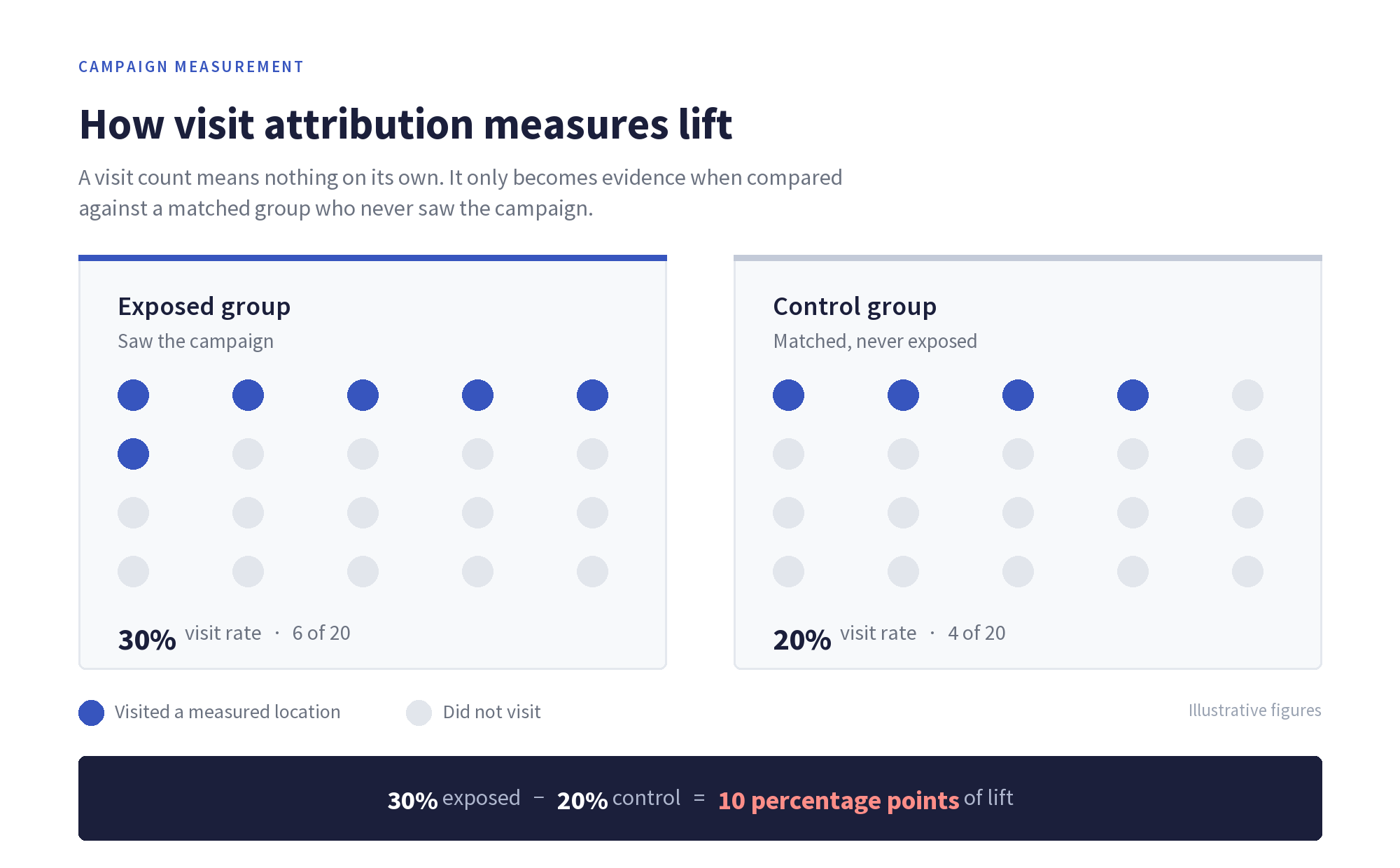
The output is not a count of visits. It is a comparison — the difference between an exposed group and a control group. That difference is the part the advertising can reasonably claim credit for.
Why click-based attribution fails for physical outcomes
Standard digital attribution follows a chain of clicks ending in an online action. That chain breaks the moment the conversion happens offline.
A shopper might see a billboard on Tuesday, think nothing of it, and visit the store on Saturday having never touched their phone in response. No click exists to attribute. Last-click models resolve this by crediting whatever digital touchpoint happened to come last — usually branded search — which systematically over-credits the bottom of the funnel and under-credits everything that created the intent in the first place.
For out of home, radio, print and much of social, this is not a small measurement gap. It is the whole picture.
How visit attribution works
The method is closer to a controlled experiment than to conventional ad tracking.
1. Define the exposed group
Identify anonymised devices that were plausibly exposed to the campaign — within range of a billboard during its run, or served a mobile impression. Exposure is probabilistic for physical media, and honest measurement treats it that way.
2. Define a control group
Identify a comparable unexposed group, matched on the characteristics that would otherwise explain a difference: location, movement patterns, time of day, device type. Without a matched control, any visit figure is meaningless — busy areas produce visits regardless of advertising.
3. Define the locations that count
Draw accurate boundaries around the places a visit could occur. This is harder than it sounds. A polygon that overlaps a neighbouring unit, a car park or a pavement will record visits that never happened.
4. Measure and compare
Compare visit rates between the two groups over a defined window. The difference is the lift attributable to the campaign.

Measurement approaches compared
| Approach | What it measures | Strength | Limitation |
|---|---|---|---|
| Last-click attribution | Final digital touchpoint before an online action | Cheap, immediate, universally available | Cannot see offline outcomes at all |
| Estimated impressions | How many people passed a site | Simple planning metric | Measures opportunity, not response |
| Survey-based brand lift | Recall and stated intent | Captures attitude, not just behaviour | Self-reported; small samples; slow |
| Visit attribution | Actual visits, exposed versus control | Measures behaviour, works for offline media | Needs quality location data and careful controls |
| Matched-panel testing | Sales in test versus control regions | Closest to revenue | Expensive, slow, coarse geography |
What the measurement requires
Visit attribution is only as good as the data underneath it, and three things determine whether the result means anything.
Positional accuracy. Consumer location data varies enormously in precision. Data accurate to within a few metres can distinguish one shop from its neighbour; data accurate to a hundred metres cannot, and will quietly attribute visits to the wrong business.
Panel scale and consistency. The exposed and control groups must both be large enough that the difference between them is a signal rather than noise, and the panel must be stable across the measurement window.
Consent and provenance. The data must be collected with valid consent and be traceable to its source. This is a compliance requirement, and it is also a quality signal — supply chains that cannot explain their provenance usually cannot explain their accuracy either. Our guide to data transparency and consented collection covers what to ask for.
Where visit attribution goes wrong
Claiming correlation as causation. Reporting raw visits from an exposed group without a control group produces a number that looks impressive and means nothing. People near a billboard were always going to visit nearby shops.
Sloppy location boundaries. Polygons drawn around a rough address rather than the actual premises are the most common source of inflated results, particularly in dense retail environments and shopping centres.
Measurement windows that flatter. A window long enough will capture visits that would have happened anyway. The window should reflect a realistic decision cycle for the category — same-day for convenience, weeks for considered purchases.
Ignoring seasonality. A campaign running into a peak trading period will show lift that the calendar, not the creative, produced. Controls need to account for it.
Visit attribution: common questions
What is visit attribution in advertising?
Visit attribution is a measurement method that connects advertising exposure to physical visits, using anonymised location data to compare visit rates between people exposed to a campaign and a matched group who were not.
How is a store visit actually detected?
By comparing anonymised device location against a defined boundary for the location, applying a dwell-time threshold so that passers-by are not counted as visitors. The threshold matters: a few seconds indicates someone walking past, while several minutes indicates a genuine visit.
Can out of home advertising be attributed this way?
Yes, and it is one of the main reasons the channel has become measurable. Exposure is inferred from presence near the advert during its run rather than from a click. Our guide to out of home advertising covers the formats this applies to.
What is visit lift?
Visit lift is the difference in visit rate between the exposed and control groups, usually expressed as a percentage increase. It isolates the campaign’s contribution from visits that would have occurred anyway.
How long after a campaign should visits be measured?
It depends on the purchase cycle. Convenience and food categories tend to use short windows of a day or two; considered purchases such as furniture or vehicles need weeks. The window should be set before the campaign runs, not chosen afterwards to suit the result.
Next steps
Visit attribution turns offline advertising from an act of faith into something measurable — but only when the underlying location data is accurate, consented and matched against a proper control.
If you are evaluating measurement for a real-world campaign, our visit attribution and measurement product pages set out how Tamoco approaches each of the requirements above, and our guide to location data explains the data types involved.


James is the head of marketing at Tamoco

