Categories
Footfall & Retail

Footfall Data Explained: Sources, Accuracy and Use Cases

Footfall data answers a question every physical business needs answered and few can answer confidently: how many people actually came, and how does that compare to last month, to the store down the road, or to the competitor across town.

It sounds like a simple count. It isn’t. What gets sold as “footfall data” comes from at least three different collection methods, each measuring something slightly different, with accuracy characteristics that decide whether the number is useful or misleading.

What footfall data is

Footfall data is a measurement of visits to a physical location over a defined period. At minimum it gives you a count. A useful dataset also tells you when those visits happened, how long people stayed, how often they returned, and where they came from.

That last dimension is what separates footfall data from a door counter. A count tells you volume. Catchment, dwell and frequency tell you what the volume means.

The three ways it is collected

Method What it measures Strength Limitation
Door counters and sensors People crossing a threshold Highly accurate at that door Hardware per site; blind beyond the entrance; no catchment or competitor view
Wi-Fi and Bluetooth sensing Devices with radios enabled nearby Covers an area rather than a line MAC address randomisation has eroded reliability; depends on radios being on
Mobile location data A consented panel of devices, extrapolated Works anywhere with no hardware; enables competitor and market-wide analysis Measures a sample, not everyone; quality depends on panel and polygon accuracy

The practical difference is coverage. Sensors tell you about your own doors. Location data tells you about everybody’s.

What accuracy actually depends on

“Accurate” is used loosely in this market. Four things genuinely determine whether a footfall figure is trustworthy.

Positional accuracy

Consumer location data varies from a few metres to a few hundred. In a retail park that difference is irrelevant. On a high street where three units share a frontage, data accurate to 100 metres cannot tell you which shop someone entered, and will confidently attribute visits to the wrong business.

The location boundary

Visits are counted against a point of interest boundary. A polygon drawn around a rough address rather than the actual premises is the most common cause of inflated numbers, particularly in shopping centres and dense retail where a sloppy boundary catches the pavement, the car park or the neighbouring unit.

Dwell threshold

Someone walking past is not a visitor. A credible methodology applies a minimum dwell time, and the threshold should suit the category: seconds distinguish a passer-by, but a coffee shop and a furniture showroom imply very different visit lengths.

Panel size and extrapolation

Mobile location data measures a sample and scales it up. That scaling is where most of the error lives. A vendor should be able to tell you panel size in the market you care about, how it splits between iOS and Android, and how extrapolation is calibrated — not just quote a global device count.

What it is used for

Site selection

Before signing a lease, footfall data shows how many people pass and stop, where they come from, and what else they visit. Catchment analysis turns a gut feel about a pitch into a measurable one.

Competitor benchmarking

This is the capability sensors cannot provide. Because location data does not require hardware at the site, you can measure a competitor’s visitation as readily as your own, and see whether a drop is your problem or the whole market’s.

Performance measurement

Refits, openings, new formats and trading changes all show up in visit patterns before they show up in reported sales.

Campaign measurement

Footfall is the outcome that offline advertising is ultimately trying to produce. Measuring it against a control group is the basis of visit attribution.

Footfall data: common questions

How accurate is footfall data?

It depends far more on methodology than on the raw data source. Positional accuracy, boundary quality, dwell thresholds and extrapolation each introduce error, and a vendor who cannot describe all four is not in a position to claim accuracy.

Can you measure a competitor’s footfall?

Yes, with mobile location data, because it needs no hardware at the location being measured. This is the main reason retailers and investors use it in preference to sensor networks.

What is the difference between footfall and visits?

Footfall is often used loosely to mean passing traffic, while a visit implies entering and staying. Any serious measurement counts visits using a dwell threshold, so the two are not interchangeable.

Is footfall data personal data?

The underlying location data usually is, and is governed by GDPR in Europe. Aggregated footfall counts are not, but the collection behind them still requires a lawful basis and valid consent.

Next steps

Footfall data is only as good as the boundaries, thresholds and panel behind it. If you are evaluating suppliers, ask about all four before comparing headline numbers — the figures are not comparable until the methodology is.

Our retail and real estate solutions set out how Tamoco approaches each, and our glossary entry on retail foot traffic covers the underlying definition.


Categories
Footfall & Retail

Leveraging Local Intelligence In The Retail Industry

In this modern era of technological advancements, it would be wrong to say that the retail market isn’t seeing similar growth. The number of online customers is evolving swiftly, and demands for more personalization are emerging. Retail industries are becoming more powerful as they are integrating with the latest artificial intelligence tools.

In 2019, the global market size of location intelligence was valued at USD 10.6 billion, and it is estimated to expand at a CAGR of 15.2% over the forecast period. Moreover, according to GSMA, the total number of IoT connections accounted for 9.1 billion in 2018 and is estimated to reach over 25.2 billion in the same period. 

Location intelligence is becoming more crucial for retailers with every passing day in providing measurable offline results, scalable audience insights, and better audience targeting. 

Here are the five ways how location intelligence proves to be revolutionizing retail industries. 

Customer Insights

If retail leaders start utilizing location intelligence, this can prove beneficial for them by provoking valuable customer insights. Technology can be used for this purpose called geo-enrichment. This technology efficiently converts customer’s residential addresses into useful insights. This way, retailers can utilize modern geographic information systems to generate smart maps and identify customer’s popular locations accurately and effectively. Retailers can accumulate information about numerous customer demographics and their behaviors. This helps business leaders to develop a better understanding of customer localities that are loyal. Business owners can optimize staff performance and have a better customer behavior experience by incorporating location intelligence in retail industries. 

Indoor mapping of retail shops is another thing that can immensely help with customer insights. Using this technology, retail stores can learn buying patterns of customers and then use this data to push different kinds of products and promotions.

Trade Area Analysis

Trade area analysis is essential for retailers to select suitable locations of a new store, define sales targets, and study competitor strength. Retailers can choose appropriate stores where they can easily access their target audience with trade area analysis. Location intelligence helps business owners have real-world insights about different customer demographics and behaviors around prospective retail sites. 

Also, business leaders can better understand which other locations their customers will consider for shopping. Thanks to location intelligence, retailers can collect data to measure customer trends and whether the customer demographic is growing or shrinking in a particular area. Location intelligence can offer data-driven approaches for trade area analysis in retails. 

Asset Tracking 

Retail businesses require a wide range of products to meet the ever-changing demands of customers. Late product delivery set’s a wrong impression on customers. This immensely affects customer delivery and staff productivity. Retailers can continuously track the location of their delivery staff and for the management of supply chains. Thankfully, location intelligence can also immensely usher identity verification of retail store staff members during asset tracking. 

Retailers can develop custom location applications that can be easily installed on mobile devices of their delivery staff. Location intelligence helps with asset tracking and can prove to be beneficial for business retailers. Business owners can track the precise location of a delivery executive in real-time and calculate accurate ETA. This way, retailers can track the location of all delivery executives on a centralized system.

Virtual Geo-Fences

Retails can set up virtual geo-fence for marketing. Business owners have the liability to define a certain radius around their store based on their store size. By utilizing this, retailers can push notifications regarding ongoing product discounts, deals, and offers when customers get in and out of geo-fence. Retailers can alert their customers by using this approach about products and discounts when they are in proximity to the store. Moreover, retailers can utilize innovative machine learning and artificial intelligence algorithms to improve sales and product suggestions. 

Let us consider an example. Suppose a customer wants to purchase coffee. There’s a high possibility that the same customer wants sugar and milk. Location intelligence is utilized for enhanced product suggestions and allows retailers to prepare themselves for ever-changing customer preferences. 

Competitive Strength Analysis 

Analysis of the competitor market is mandatory for retailers and business owners before selecting a new retail site. Location intelligence proves to be a game-changer in this scenario. Location intelligence assists business owners in measuring competitor’s market share and perforation in a particular geographical location. Also, this helps retailers to understand customer’s loyalty to themselves and their competitors. If their customers tend to visit other stores, the retailers can utilize this opportunity in the best possible way and capture less loyal customers of their competitors. A retailer can use Data-driven approaches with the help of location intelligence. 

Invest Today For Long Term Business Protection

Location intelligence has great potential to protect your business against criminal acts and fraudulent activities in the long term. Today, everything is prone to digitization due to the rapid evolution of technologies. The utilization of data and insights from experts for efficient and accurate business decisions is becoming a new normal, proving to be revolutionizing the world. 

In this current competitive environment, if you want to enhance your business’s security, it’s high time to invest in location intelligence technology. The utilization of local-based data helps the identification of those areas where you are overspending and underspending. Moreover, it helps develop a better understanding of your business operations and identity area of enhancements and how your retail store operates. It is much more straightforward to prove your compliance to stakeholders and customers with precise and versatile map data. Just start investing today for the long-term protection of your businesses. 

Related: read more about how location data is used across retail and real estate.

Categories
Footfall & Retail

How Retailers Use Geospatial Data To Create Better Marketing Campaigns

If you’re a retailer, you know the importance of marketing your business digitally. You also know that your ability to effectively market to a consumer is what wins it for you. But, have you considered location-based marketing through geospatial data?

In this article, we are going to go over what geospatial data is, the benefits of utilizing geospatial data, and examples of retailers who use GIS for location-based marketing. 

First, let’s define geospatial data. What is it? 


What is Geospatial Data? 

Geospatial data is the use of technology, such as GPS, to create and store digital maps that help retailers better understand their customers. This information can be used to geotarget based on location and demographic information allowing marketers to create better-customized marketing campaigns in the long run.

The main use case for geospatial data is to segment audiences based on proximity to a location, but that’s not all it can do. Geospatial data can help you understand who your customers are, where they live, and how they spend their time outside of work hours — which can help you create marketing campaigns that drive results. 

Now that we went over the basics of what geospatial data is, we are know going to discuss some of its benefits as it relates to marketing. 


3 Benefits (and Examples) of Geospatial Data for Marketing

Did you know that 95% of executives across the globe believe that geospatial data is critical for achieving business success? Well, it’s true! Geospatial data is one factor that can really send your business over the edge allowing you to make better data-driven decisions for your overall business. This includes digital marketing as well. 

Still on the fence about marrying the concept of  GIS and marketing together? Here are three benefits of GIS marketing and examples of some of the top-name retailers who use GIS to improve their marketing efforts. 


Brings More Foot Traffic to Stores

Geospatial data is used to understand where shoppers are, where they’re going, and what they’re doing as they move around both inside and outside their stores. Retailers can then use this information to create tailored marketing campaigns that draw in more customers to their stores. In addition to this, geospatial data can also be used to keep customers in your stores longer.


Example: Sephora is Able to Better Segment Customers with Geospatial Data

Beauty retailer Sephora uses geospatial data to send its rewards members a pop-up notification anytime that a customer is in close proximity to one of its stores. The pop-up will generally have a marketing offer to come in for a “free mini makeover” making it almost too enticing to pass up — especially if they are already in the area. 

Once they are in the store, app users can visit the app to get personalized recommendations and to view reviews and product features in the easy-to-use platform. 


Better Targeted Advertising

Geospatial data allows your marketing teams to create better, targeted advertising campaigns that’ll drive your bottom line

For instance, let’s say you have a flower shop. You would want to pinpoint important location information of what neighborhood your ideal customer may live in and work in to ensure that any advertisement you launch online is shown to those specific groups of people. 

Through the power of geospatial data, incorporating target market data, you’ll be able to set more precise targeting parameters in your digital advertisements.


Example: Under Armour Uses Location-Based Marketing through App

An example of a company that uses geospatial data for digital marketing is Under Armour. Under Armour uses GIS through its Map my Fitness app to give its users better-targeted advertising. From tracking the type of activities you do to knowing geographically where you’re located, the Under Armour fitness trackers are pretty robust in their tracking features allowing the company to market its users more effectively. 

How does this look in action?

If you use the Map my Fitness app to track your runs, you may start to get more advertisements for Under Armour running shoes. If you actively use the app in a location with a colder climate, you may start to see more advertisements for the Under Armour base layer. The list goes on. Through the app, the company is able to up-sell and cross-sell seamlessly without coming off as too “salesy”. 


Enhanced Personalized Messaging

Personalized messaging has been proven to have significantly higher engagement rates than non-personalized messages. In fact, 90% of consumers find personalized marketing more appealing than the latter. 

Geospatial data allows your teams to send out personalized messaging based on where your customers are located and what they’re doing at any given moment. Pretty neat right? Let’s take a look at how Ritual creates personalized messaging by using geospatial data. 

Example: Ritual Ordering Food App utilizes Personalized Messaging with GIS

Ritual food ordering app is known to connect users with restaurants in the area based on historical purchasing habits. (It’s similar to DoorDash or Uber Eats.) 

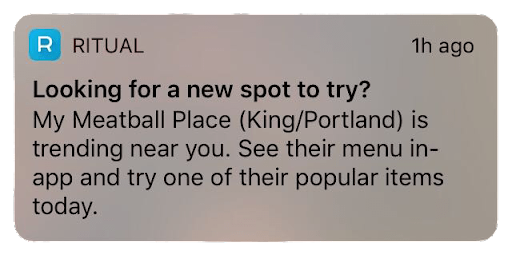
Ritual does a great job when it comes to personalization. The company will send personalized notifications to its users with food recommendations based on both area and taste preferences. These simple but powerful pop-up notifications make the customer more likely to open the app and place an order. They may not exactly purchase from the restaurant you suggest, but it gets them curious (and hungry) to find the right food place to make an order at. 


Transform Your Digital Marketing Efforts with Geospatial Data

All in all, geospatial data is everywhere. It’s one of the most important elements for marketers and advertisers to understand if they want to accurately target their audience. 

As a recap, geospatial data can: 

  • Bring more foot traffic to your store
  • Help you create better-targeted ads
  • Enable you to send out more personalized messaging

As more and more location-based data becomes available to retailers, it has become even more important now than ever before for retailers to use that data to their advantage. If not, you are missing out on the opportunity to improve your reach to those who need to see your message the most: potential customers. 

Related: read more about how location data is used across retail and real estate.

Categories
Footfall & Retail

What Is Footfall Data? All You Need To Know About Foot-traffic In 2026

Footfall data is something that has been around for a while now. But what do we mean by footfall?

This kind of dataset has changed depending on the use case and industry.

In fact, footfall has moved beyond simply measuring the number of people that enter a location.

We’ll take you on a deep dive into footfall data. We’ll show you what it is with detailed examples, as well as what it can be used for across many industries.

What is footfall?

Before we look at footfall data, we need to explain what footfall is.

For us, we have always defined footfall as:

The way that a group behave and move in the real world.

This explains the who, what, when and why of how this group of people visit a location.

This could be different for each business.

But mainly footfall can tell you:

  • Trends around behaviour
  • Changes in demographics
  • Visits to real-world locations
  • Anonymised data trends

Essentially footfall means understanding how people move and behave in the real world.


So what is footfall data, and what does it look like?

Footfall data is sometimes referred to as foot traffic data. It’s a data set that will usually contain a number of entries. 

The dataset as a whole will signify a number of visits to a real-world location.

These are aggregated and delivered in a few different ways.


Aggregated visits to a location

This will be a data set in which the number of visits to a location is aggregated. This is usually done by some kind of time window, such as hourly, daily, weekly or monthly.


Individual visits to a location

Similar to the above, but this time each row will signify a visit to a location. This will usually come with a timestamp and will be up to the person receiving the data to aggregate the data as they wish.


Characteristics of visitors at a location

In this dataset, the visits to a location are overlayed with demographics data to understand the calibre of person visiting the chosen location.


Comparisons of visitors to a location

This dataset will contain a comparison between two locations based on the desired metric. This could be demographic or an hourly number of visits.


Where is footfall/foot traffic data generated from?

These datasets can come from a myriad of sources. It’s important that you understand where your footfall data is generated from, as this can affect its accuracy. The most common sources are as follows:


Geospatial/Location data

Data is usually generated from a mobile device. This is collected and aggregated to protect user privacy. A good amount of versatility as a single data set can be used to measure visits to numerous locations. A good balance of scale and accuracy.


Sensory data

These are usually physical sensors that are placed in entrances to stores. Very accurate but limited mainly to retail and requires stores to install physical tech, so not very scalable.


Purchase data

This kind of footfall data involves taking payment data to understand changing traffic in stores. It can be scalable but is not very accurate. This is mainly due to the fact that you are measuring purchases as opposed to visits.


How can footfall data help my business?

Traffic and movement trends

One of the main use cases for footfall data is for understanding changing traffic and movement trends.

These kinds of insights are valuable for businesses that are interested in physical locations. 

Examples of this use case are:

  • A retail location understands the changing number of visitors to its location. This could be a store or a real estate planner.
  • A city planner understands macro visits changes to plan infrastructure.
  • Financial companies looking to identify trends in behaviour for investment purposes.
  • OOH media owners measure how many people have seen their ads.


Visitor demographics

As mentioned, with overlapping datasets, it’s possible to show the demographic of visitors to locations. These demographics are features such as age, gender, interests. 

This use case traditionally sits more on the side of marketing and advertising. 

Example use cases are:

  • Marketers target consumers who have visited a real-world location.
  • Building lookalike audiences in advertising platforms.


Competitive analysis

This is similar to our first use case, but the target location will typically be a competitor. 

Examples of this use case are:

  • A store measures competitors’ traffic to target them with advertising.
  • A new site planner understands competitive performance to decide where to open a new site or venue.


Training ML

Footfall data can also be used to train emerging ML models. These models are being used to power new tools that can help solve problems in the real world.

Examples of this use case are:

  • Predictive insights into footfall
  • Complex financial predictions


Example of footfall data

Get started with best-in-class footfall data today.


Related: read more about how location data is used across retail and real estate.

Categories
Footfall & Retail

How Does Gold Price Live Data Empower Online Retailers to Boost Customer Trust?

Have you noticed how global gold rates constantly fluctuate due to market and economic factors? Did you know real-time rate-setting information helps businesses understand the true value of this precious metal? Trusted platforms providing accurate live data are essential for maintaining transparency in pricing strategies. However, building customer dependability requires consistent communication, fairness, and offering reliable insights about product charges.

Displaying gold price live data ensures customers feel confident and informed when buying. Online gold retailers rely on accurate insights to balance profitability with customer satisfaction and loyalty. Here, we highlight how live information impacts transparency, trust, and online business success. By reading, you will learn effective strategies to strengthen customer confidence and improve sales outcomes.

Enhancing Transparency

Displaying live gold prices ensures customers see updated rates reflecting the current market. Trusted platforms offer real-time insights to help retailers maintain accuracy and transparency for their buyers. Accurate information eliminates doubts about hidden costs, strengthening consumers’ confidence in their purchasing decisions. They value clear rate-setting practices and rely on retailers demonstrating fairness through real-time data integration. Building transparent relationships through trusted sources fosters loyalty and long-term dependability between retailers and their buyers.

Building Credibility Through Accuracy

Providing accurate, real-time rates showcases a retailer’s commitment to honesty and professional reliability. Trusted sites delivering real-time insights ensure pricing is consistent with market conditions. Customers trust businesses that prioritize accuracy and provide timely, reliable pricing information. Credibility grows when retailers use verified data sources to enhance transparency and eliminate valuation inconsistencies. Accurate, live information builds a secure foundation for buyers to make purchasing decisions confidently.

Facilitating Informed Purchasing Decisions

Access to price updates empowers end-users to make decisions that align with market conditions. Ecommerce retailers relying on trusted platforms provide accurate updates that ensure buyers feel confident and informed. Informed decisions lead to higher satisfaction and greater reliability in the retailer’s commitment to transparency. Data-driven insights position eCommerce stores as reliable partners prioritizing customer awareness over profit margins. Leveraging accurate data strengthens the bond between businesses and their consumer base, creating a foundation of trust and repeat engagements.

Aligning with Market Conditions

Up-to-date price updates allow online stores to seamlessly align their product pricing with market fluctuations. Trusted data sources ensure adjustments reflect current conditions, preventing overcharging or undercharging for products. Fair pricing strategies rooted in live data build buyers’ trust and strengthen the retailer’s reputation. Clients appreciate fairness and accuracy, recognizing when businesses prioritize ethical and transparent valuation. Aligning cost structures with reliable metrics fosters confidence and encourages repeat purchases.

Enhancing Customer Engagement

Offering up-to-date data on rates enhances customer engagement by informing them about market trends. Reliable platforms providing live updates encourage customers to revisit websites frequently, fostering continued interaction. Regular exposure to accurate metrics positions retailers as trusted resources in their customers’ decision-making journey. Frequent engagement builds familiarity and loyalty, which is essential for cultivating strong buyer relationships over time. Live data offerings transform consumer engagement into deeper reliability and long-term brand loyalty.

Trustworthy strategies begin with reliable access to accurate and updated gold price live data. Reputed platforms provide real-time insights that help businesses maintain fairness and transparency in pricing. Accurate live data empowers businesses to build stronger relationships and increase buyers’ reliability. Leveraging reliable information ensures online retailers can respond effectively to market changes while protecting customer confidence. Invest in dependable sources to enhance credibility, optimize valuation strategies, and grow your business successfully.

Related: read more about how location data is used across retail and real estate.

Categories
Footfall & Retail

How to Organize a Retail Team for Better Performance and Sales

Retail is not an easy job and includes many challenges, but the best results are achieved when you have a specially organized and dedicated team. That’s why we are here to help you build a solid team and improve its performance.

As a team leader, you have many responsibilities and play a key role in the success of your company. One of the most important tasks that impacts your business results is to lead a truly engaged team.

Did you know that companies with highly engaged teams are 21% more profitable?

Disengaged employees working at a minimal level could have a greater impact on sales if they feel part of something, part of a team, part of a business, and part of your success. 

Let us look at what you can do to improve the organization of your team and shoot those key indicators through the roof.

One powerful way to boost team performance and store efficiency is by adopting smart tools like convenience store inventory management systems. These solutions take the guesswork out of stock control, reduce manual tasks, and allow your team to focus more on customer service and strategic growth. With the right system in place, your staff can stay more engaged, more productive, and better prepared through sales team training, and more aligned with your business goals.

The 6 strategies to organize your retail team and boost their performance

Provide reliable retail sales scheduling software

In order to think about certain tactics, you need to have a system that builds a foundation. It’s very convenient to use retail staff scheduling software and one of the current-best on the market is Agendrix Retail Scheduling Software, which manages everything automatically. By eliminating the manual work, you can really save a lot of wasted hours.

They solve all the short-term scheduling problems and keep the team’s activities up to date. These systems are managed with messaging systems, real-time notifications and everything you need to stay connected at all times.

The main advantages for you are: 

  • Time savings
  • Open pop-up windows where employees can move their schedule as needed
  • Lower administrative costs
  • More efficient recording of working hours
  • Creation of schedules

It optimizes time so you can focus on what matters: improving their performance.


Hire a good attitude

Hiring the right people is the key to a good retail team.

Your task is to build a team that promotes a good working atmosphere. Each part is important to create synergies between all, with each member complementing and supporting the others. Your job is to pass on to them an attitude of learning and continuous improvement.

The key is to hire employees as they are and train them based on their aptitude. Screen and hire the best candidates carefully, making sure they not only have the necessary skills to sell and perform well, but also the right attitude and ability to adapt to the company culture and fit perfectly into your team.

It’s much easier to train a positive person, who is willing to learn and who shares your values, than to change the attitude and disposition of someone who does not have a natural inclination towards service. Engaged and positive employees are the ones who will keep customers coming back and spending their money in your store.


Drive employee engagement and customer loyalty together

If your staff genuinely thinks that your product has value and adds meaning to someone’s life, they will be able to communicate that to consumers. This includes providing good training instances for everyone and showing each of them what you offer.

The link between employee engagement and customer loyalty is becoming increasingly clear, and that’s true in retail, too. Now, 89% of customers say they’ll consider a purchase if a seller changes their way of thinking. Your customers will keep coming back if they are well taken care of and given a clear explanation and guidance. 

Your goal is to position the brand and communicate values, and the team responsible for promoting your product in stores must be clear about these values, its competence and added potential. 

If you aim for sales success, it’s essential that the workforce know everything they need to know in order to respond properly to each customer. To do this, you need to ask yourself:

  • Have you conducted internal marketing campaigns to announce a new product? 
  • Have you run campaigns to explain to your team who you are and what sets you apart from the competition?

If not, you have work to do. The idea is to convey the value of your product to them with passion, so they can pass it on in the same tone. Work actively on this.


Define optimal ground rules

The people who make up your team demand that you take concrete, directional action to facilitate their work and motivate them. Rely on:

  • Clearly define the tasks to be accomplished
  • Set achievable goals
  • Actively assess and monitor performance
  • Evaluate results
  • Establish good internal communication
  • Develop career plans
  • Pay accordingly and create an emotional salary
  • Establish a customer-centric culture
  • Build loyalty among your salespeople

To be a true leader, you must inspire with your attitude, encourage the personal and professional development of your teams, and be honest about your intentions. Leading intelligently requires good policy and an optimal business methodology. This is the key.


Delegate in a systematized way

Establish hierarchies and optimize productivity within the company by defining work structures appropriate to growing. Centralizing control to a single person is a barrier to agility and business growth. It’s not only important to delegate tasks, but also to trust and instill confidence in subordinates. 

Success lies in giving them autonomy and the ability to make their own decisions. Usually, managers of fast-growing companies are used to controlling all operations and being above everyone else. This is a mistake that costs a lot of time and money.

Be willing to delegate, take their advice, and rely on the solutions they provide to improve sales. This is critical to the success and future of the company.


Invest in improving your leadership skills

You may have decades of retail experience or just be starting out now, but there are always ways to improve your skills. One way or another, you will always need to actively drive sales, and that requires training in performance skills that you can pass on to your employees. Rely on:

  • Find opportunities for your personal continuing education and training
  • Ask your teammates to evaluate your work and be open to suggestions
  • Check what your competitors are doing to train and update their leaders

For example, if you want your employees to know your products extensively, make it easy for them. Use the products, study all the details, research your competition and keep them up to date on what’s new and prepare them to sell more and better. 

Proper people management will help you develop your own potential, keep your team motivated and engaged, help them act responsibly and independently, sell confidently, and grow personally while helping you grow your business.


Give plenty of incentives and rewards

A reward system is necessary to maintain motivation every day for the whole team. It’s also an opportunity for you to make the connection between good performance and fulfillment. Nothing increases an employee’s overall satisfaction more than the feeling that they can go as far as they want.

Start by setting performance goals and a system that staggers rewards. Don’t forget to include aspects that are related to management but equally important: 

  • Attendance
  • Good behavior
  • Teamwork
  • Focus on results

An employee must feel valued to maintain a solid performance, so it’s important you create incentive systems, both for meeting goals or metrics and for meeting basic requirements like schedule. If you reward your team constantly, they’ll be more motivated and results-oriented.

You can give things such as office supplies, personal items, or gift cards. They can also be less tangible, such as courses, scholarships or recognition systems. They all have a direct impact on the development of group and individual motivation.


Common aspects for optimal organization

Organizing a successful sales team requires open leadership. As a leader, you must be prepared to address all necessary aspects, such as:

  • Provide the software and programs that support the administrative work: In this way, focus on the human side and do not waste time on technical aspects. Try to invest enough to support the work of your company
  • Hire people who have the ability to adapt to change and have the best possible attitude: It is not the same to invest in training and improving skills than to constantly spend resources in endless selection processes
  • Communicate with your employees the same way you do with your customers: If you make an effort to retain employees, it will have a direct and sure impact on customer retention
  • Set clear, concise and realistic work rules: If you communicate directly what you want, your employees will be better organized to meet your needs
  • Learn to delegate and not overload yourself with work: Trust your team and trust that they have what it takes to take on any challenge
  • Invest in yourself and everything you need to improve your role as a leader: from formal training to simply asking for feedback from your teammates
  • Pay your team accordingly, reward them, and incentivize them: congratulations may better performance for a day, but good working conditions can improve performance and loyalty in the long run

You now know everything you need to know to optimize and organize your employees to perform better than expected. Start implementing these changes now and prepare to achieve real long-term results.


Related: read more about how location data is used across retail and real estate.

Categories
Footfall & Retail

Benefits Of Effective Inventory Management And How It Improves Retail

The topic of inventory management may not be the concern of the world but it is a concern for almost every business. 


Inventory management plays a great role in running your business. Effective inventory management helps your business improve its sales, customer satisfaction, and overall performance of your business. On the other hand, ineffective inventory management makes your business suffer from loss and ultimately less profit. 


Inventory management includes all the information regarding the purchased material for initial orders, stocking up the warehouse from goods and items, delivering orders, and storing the unsold items. There are several benefits your business can reap if you do inventory management properly. Here is how effective inventory management helps your business. 


It saves you money and time

Effective inventory management keeps your business safe from loss. It allows you to keep track of how many sales you’ve made and how much time you have remaining until the products expire. It helps your business in reducing losses by keeping track of which products are approaching their expiration dates. If you retain these products, they will be useless. 


So, once you know which products need immediate sales, you bring them in front so they get visible to the customers and they purchase them. in this way, there will be no wasting of those products and ultimately no losses. 


It increases customer satisfaction

Effectively managing cash flow involves monitoring inventory to discern fast and slow-selling products. This data-driven approach empowers you to optimize stock for high-demand items and enhance slower-moving products. Such strategic inventory management is instrumental in maintaining a robust cash flow for your business.


It improves cash flow

When you keep tracking your inventory, you would be able to know which products are selling fast, and which products are slow-selling products. In this way, you can increase the stock for fast-selling products and make improvements for slow-selling products. 


Organized warehouse

Another advantage of operative and effective inventory management is that it keeps your warehouse orderly and organized. Through smart inventory management, space that is occupied by slow-selling products can now be free and refilled with fast-selling ones.

Furthermore, maintaining an organized warehouse isn’t solely about optimizing space for high-demand items but also assessing the structuring of warehousing systems themselves. A crucial aspect is ensuring that your pallet racking components are routinely inspected. Implementing a pallet rack maintenance checklist allows businesses to identify and address potential structural issues timely, thereby safeguarding inventory and enhancing overall efficiency.


How To Improve Inventory Management?

Due to ineffective inventory management, your business can lose sales due to the shortage of products and your business also loses its customers. 


A business that keeps popular items in stock has good control over its cash flows. Effective inventory management can help your business have better practices regarding inventory and thus make success. There are several ways you can improve your inventory system. Let’s take a look at some of them:


Set limited stock

One of the best ways to achieve the best inventory system is to stock your warehouse with limited inventory. It is always wise to set limited stock for those products which are selling slowly. Make sure you have those products available in your warehouse which are in demand from the customers. Exclude all unnecessary items.


Track inventory

Tracking your inventory allows you to know which products are going to finish so you can restock those products to avoid inconvenience for the customers. 


Tracking your inventory involves the tracking of everything from raw material supplies to tracking the products in your warehouse to know which products are sold and which need to be restocked and which products are going near expiry date. Tracking UPC is another option you can implement to know when the manufactured products are going to be in your warehouse. 


Minimum or no spoilage

You must avoid spoilage from your inventory. Make sure you know which products are about to expire, use the FIFO rule (First In First Out), and manage your products according to this method. Keep tracking the exploration dates of the products so you don’t have to wash your money by wasting those products. 

Seeking professional expertise, particularly from warehouse and logistics consultants, can greatly optimize inventory management. These experts provide insights to streamline operations, improve inventory tracking, minimize losses from expired products, and foster an organized warehouse environment, leading to better business outcomes.


Do regular audits

Nothing can beat the importance of the audit for your inventory system. Auditing inventory is an excellent technique to determine how many goods you’ve sold, how many remained in the stock, and how many products you have to order for the next sale process. Audit inventory helps you manage it efficiently. 


Be alert for emergencies

While keeping stock at the best level is the main objective of the business to serve its customers. There can come times when the demands from the customers get high and you don’t have enough stock available in your warehouse. Prepare for the unexpected. To satisfy the consumer, gather more suppliers and allow for urgent shipping rates if needed.


Invest in technology

When you are a small business you can do all the work on paper and make spreadsheets for your inventory management. But as your business grows, You’ll either spend more time on inventory management than on your other business operations.  


All of these activities can be made easier by using proper inventory management software which can automate your inventory tasks. Before you choose software, make sure you know what you need, and which is simple to use. 


Related: read more about how location data is used across retail and real estate.

Categories
Footfall & Retail

5 Ways to Use Geospatial Data to Optimize Store Layouts

You walk into your favorite clothing store, and bam! – everything’s moved around again. It’s like they rearrange the place every other week. Don’t they know how annoying that is? Next time it happens, just know there’s a method to this change. Retailers use geospatial data to design their floor plans. It helps them figure out where to put everything in the store to get you to buy more stuff. Pretty sneaky, right?

But don’t look at it negatively because the owners of your favorite store have to sell products to remain in business. If you own or manage a retail store, here’s how geospatial data can help you optimize your store layout.

Understanding Geospatial Data and How It Applies to Store Layouts

To optimize your store’s layout with geospatial data, you first need to understand what it is. Geospatial data is information about the location and attributes of objects on Earth. If you own or manage a retail store and need to use geospatial data, you first need to gain knowledge about this subject.

Content posted on reputable websites, a subject expert offering a college essay writing service, videos, and social media are some of the options you can use to gain knowledge quickly. When applied to retail, geospatial data can provide insights into customer traffic patterns, product placement, and more. It helps you:

Gather Customer Location Data

By tracking the locations of your customers’ mobile devices in-store, geospatial data can show you which areas of the store get the most traffic. You can then place popular products in high-traffic areas to increase sales.

Analyze How Customers Move Through the Store

Geospatial data provides a heat map of the paths customers take through your store. See which aisles and displays they frequent and which they skip. You may find opportunities to reorganize product placement or make structural changes to improve the customer experience.

Identify Prime Shelf Space

Every inch of shelf space in a store is valuable real estate. Geospatial data can pinpoint which specific shelves, displays, and racks get the most attention. Focus your merchandising efforts on those prime locations to maximize sales and profits.

By leveraging the power of geospatial data, retailers can make evidence-based decisions about store layout and product placement. The result is an optimized shopping experience that keeps customers coming back. Analyzing how people interact with your physical space provides insights traditional sales data alone can’t offer. As a result, geospatial intelligence is a tool no retailer should be without.

Track Traffic Flow

Geospatial data provides insights into your customers and their behaviors within your store. By analyzing how people move through the space, you can make changes to create the optimal layout.

Using the data gathered, you will be able to see how customers navigate your store by analyzing their movement patterns. Then, look for areas with high and low traffic to determine the ideal placement of products and promotional displays. You may find that people tend to turn right upon entering, so put high-interest items there.

Determine Dwell Time

Pinpoint areas where customers linger to find your “hot spots.” Place impulse purchase items there, and consider making aisles wider and more open. In low-dwell areas, you can pack in more inventory or use the space for backroom storage.

Evaluate Display Effectiveness

Track how many people interact with a product display to measure its success. If few people stop to look, try a new location, or switch out the products featured. Displays with high engagement are keepers – you know you’ve grabbed customer interest there!

Identify Problem Zones

Look for “dead zones” with minimal foot traffic to uncover issues like bottlenecks, cluttered aisles, or lack of signage that deter customers. Make necessary changes to open up the space and draw people in. Clearing the path can significantly impact sales.

Tailor Your Store to Customer Preferences

Note differences in navigation patterns and dwell times for return customers versus first-time shoppers. Repeat customers will move more purposefully to the products they want, while new customers meander and explore. Cater your layout to quickly engage new shoppers and make returning convenient for loyal customers.

How Geospatial Data Helps You Optimize a Store Layout

Geospatial data gives you a “bird’s eye view” of your store space and customer traffic patterns. By mapping out where customers linger, the paths they take through the store, and which areas get little foot traffic, you can make data-driven decisions about product placement, endcaps, and signage to improve the customer experience.

While geospatial data collection does require some investment in hardware like security cameras or Wi-Fi routers, it doesn’t require you to be an expert on data analysis. Much of the analysis can be done with free or low-cost tools. So, instead of worrying about how to collect and analyze geospatial data, hire a reputable company to do the job on your behalf. That way, you can relax and use the free time to engage in a hobby, be it gardening, painting, or reading an essayusa review.

Analyze the Data Often

You don’t need a huge volume of data to start optimizing your store layout. Even collecting geospatial data for just a few days can reveal patterns that lead to impactful changes. The key is focusing your data collection on high-traffic periods like weekends or seasonal events. Start with a targeted pilot in just one zone or department of your store. Once you see the benefits, you can expand data collection storewide.

For the best results, take an iterative approach to optimizing your store layout with geospatial data. Start by optimizing one area or product category at a time and review the data for that section weekly or monthly to see how customers are responding. Over time, you’ll get better at spotting opportunities and making more effective changes. Continuous small optimizations, informed by current data, will keep your store layout as agile as possible.

Final Thoughts

With geospatial data at your fingertips, you have insights to transform your store into a space that truly puts the customer first. Analyze, evaluate, and tweak your layout to lead people effortlessly to more of what they want. An optimized store means an optimized customer experience – and that’s the real key to sales success.

Related: read more about how location data is used across retail and real estate.

Categories
Footfall & Retail

How Real Estate Agencies Can Make Data Driven Decisions With Geospatial Data

No matter what type of business you are in, there is no denying the importance of geospatial data as it relates to literally every area of your company from marketing to planning and everything in between. In terms of real estate, in the coming years any real estate agency that doesn’t make use of and rely heavily on geospatial data will almost certainly be left behind. In order to understand that rather marked and definitive statement, it is first important to understand exactly what geospatial data is, how it is collected, and why it is especially relevant in real estate.


A Brief Definition of Geospatial Data

In its simplest definition, geospatial data is that which is descriptive of any event, object or feature located on or very near the earth’s surface. It is typically a combination of:

  • Location (coordinates)
  • Characteristics (relating to objects, phenomena, or events)
  • Temporal Information (point in time or lifespan)

All of which play a significant role in reading data with the intent of forecasting future events or movement.

For example, let’s look at how geospatial data helped to track and forecast the movement and spread of the SARS-CoV-2, Covid-19 pandemic. Temporal data gave us a short-term location of what was to be the pandemic in late 2019. We know that the location was Wuhan, China and thought to have originated at one specific market which then became ground zero on the geospatial chart. From there a long-term progression of the pandemic showed its movement outward which are temporal and location data. Along with characteristics such as how it was spreading, scientists became better able to forecast its movement around the globe and as early asMarch of 2020 a global pandemic was announced. 

Even then, it was too little too late because some of the much-needed data was not forthcoming soon enough to predict an accurate geographic spread and rate of spread. Had geospatial data been shared better in the early days, many virologists and epidemiologists believe the pandemic may have had better outcomes earlier on. With that, you can see just how important it is in forecasting business dynamics going forward.


How Real Estate Can Benefit

In the real estate market properties for sale have always been valued primarily on location and what we knew about that that particular property in terms of the condition it was in and what was going on around it in the general vicinity. Were there plans for future development and if so, how would that affect a particular property that an owner wanted to list for sale. Realtors and assessors would look at other properties in the area to see what they had sold for in order to relate that price to the property in question. This is how comparables were calculated and how an actual list price and marketability were determined.

With advances in technology, geospatial data can actually have a profound effect on the profitability of a piece of commercial property. Instead of using historical data to predict a given market going forward, temporal data gathered and analysed in real time can indicate what that property is worth today in the here and now. To be specific, comparables calculated even a week previous to a major break in a pipeline may not be relevant today. That property would be greatly devalued if the repairs would be weeks or months in coming. Real time data can affect the price today and that’s why the real estate market will, at some point in time, need to rely on what is happening on the ground at a very precise location.

Furthermore, leveraging advancements in real-time property imaging through tools like Giraffe360, agents can create immersive virtual tours and detailed visual content. This not only enhances a property’s appeal but also provides potential buyers with a comprehensive understanding before an on-site visit.


A Key Selling Point

Conversely, if new schools are being built, for example, and an influx of families are moving into a neighbourhood, a commercial venture for a theme park might want to jump on a parcel of land zoned commercial. Satellite imagery would show that kids are out playing in fields and on side streets with few parks and nothing in the way of entertainment. It would take weeks, if not longer, to collect that kind of data without the benefit of a literal bird’s eye view from above and a poor data set can have a terrible effect on the real estate market.

AI could possibly collect data on the types of commercial or public properties families might frequent already in existence, but even that isn’t quite as all-encompassing as actually seeing movement on the ground. Just because a property exists doesn’t mean it is being frequented by the locals. Satellite imagery would document that and indicate whether or not there is a need for family entertainment at this time.

Imagine what a real estate agent could do in the Greek Islands with information like that? As a popular tourist destination, geospatial data could indicate what kinds of attractions are being frequented, which are ignored, and what types of venues would do well in areas with currently high levels of traffic. It’s interesting to imagine just how this type of data can, and will, affect the real estate market going forward. One thing is for sure. Geospatial data will almost certainly replace the archaic system of buying and selling real property based on comparables. That’s a given.

Related: read more about how location data is used across retail and real estate.

Categories
Footfall & Retail

6 Inventory Allocation Strategies for Multi-Location Retailers

Managing inventory across several retail stores is a major hurdle. Each store has unique needs and constraints, making it difficult to keep just the right amount of stock. Interestingly, a recent study found that 43% of small businesses don’t manage their inventory at all, which stresses the need for strong inventory management techniques.


In this blog post, we’ll explore six fresh methods tailored for retailers with multiple stores to overhaul how they handle their stock. These include using the latest technology and making choices based on data, which could significantly boost efficiency and profits across the board.


Invest in Inventory Management Software

In our current era of technology, it is more necessary than ever to adopt inventory management software. These advanced software solutions offer various features that help streamline the handling of inventory across different locations. Take, for instance, a clothing store that invests in specialized inventory management software tailored for apparel businesses. This software not only keeps track of inventory levels in real-time across various locations but also offers advanced features customized specifically for the apparel sector.


With functions like managing size and color combinations, predicting styles, and analyzing seasonal trends, apparel inventory management software empowers retailers to make allocation decisions with precision. By making use of such specialized software solutions, retailers can improve visibility, accuracy, and efficiency, ultimately boosting profitability in their operations.

Implement Demand Forecasting Techniques

Getting a handle on demand predictions is crucial for smart inventory management. By diving into past data, analyzing market trends, and using predictive models, businesses can peek into future demand trends. But remember, demand changes over time due to factors like seasons, promotions, and market shifts.


Tweaking forecasts based on these factors helps businesses manage inventory better, reducing both stock shortages and surplus stock while making the most of sales chances. Plus, including customer feedback and market studies can improve the accuracy of demand predictions, giving businesses a fuller picture of consumer actions.

Adopt ABC Analysis

ABC analysis serves as a useful method for sorting inventory according to its significance and value. This method sorts items into three groups: A, B, and C. By doing so, companies can better direct their focus and distribute their resources. High-value items in category A typically need more careful control, whereas less valuable category C items can be managed with less oversight.


By understanding the traits of each category, businesses can tailor their allocation strategies to suit individual needs, enhancing inventory management across various sites. Furthermore, regularly reviewing and adjusting these classifications ensures that allocation tactics remain in line with changing business priorities and market dynamics.

Utilize Just-In-Time (JIT) Inventory Management

JIT inventory management streamlines operations by slashing storage expenses and surplus stock. By aligning stock levels with customer demand, businesses can cut waste and boost productivity. Adopting JIT principles demands solid partnerships in the supply chain and smooth logistics to ensure uninterrupted stock movement between sites.


Though JIT can present hurdles in terms of supply chain stability and adaptability, the perks of lower carrying costs and enhanced inventory turnover validate it as a valuable tactic for retailers with multiple locations. Moreover, fostering teamwork among departments and suppliers can amplify the effectiveness of JIT adoption, empowering retailers to swiftly adapt to shifts in demand and market dynamics.

Implement Cross-Docking

Cross-docking is a logistics strategy where incoming goods are immediately transferred to outgoing transportation without the usual holding steps. This skips traditional storage phases, enabling companies to reduce delivery times, decrease handling expenses, and accelerate inventory turnover. To make this approach work, precise planning of transport routes and timing across different points is essential.


Moreover, this strategy improves communication between suppliers and businesses, helping them react swiftly to shifts in customer demands. It also boosts the flexibility of supply chains, helping businesses quickly adjust to changes in the market and seasonal variations. However, implementing this strategy effectively demands a solid logistics setup and active cooperation among all parties involved to ensure smooth operations.

Embrace Data-Driven Decision-Making

In the current era where information is abundant, retailers can tap into extensive data to shape their inventory distribution tactics. Analyzing data on sales, stock rotation, and customer habits provides crucial insights that help refine these strategies. Tools like data visualization dashboards simplify this analysis, presenting clear, actionable information.


Using predictive analytics, retailers can also forecast future buying trends and adjust their inventory plans accordingly. This forward-thinking approach reduces the likelihood of running out of stock or having excess goods, thereby maintaining optimal stock levels and boosting operational effectiveness. Additionally, basing decisions on data allows retailers to tailor their inventory strategies to meet the specific preferences and purchasing patterns of their customers, increasing customer satisfaction and fostering loyalty.


Final Thoughts

For multi-location retailers, mastering inventory control is critical to thrive in the competitive retail environment today. This can be achieved by adopting sophisticated inventory management software, implementing demand forecasting, conducting ABC analysis, adopting just-in-time inventory strategies, utilizing cross-docking, and making choices based on solid data.


Doing all this helps distribute inventory smartly, cut down on costs, and rake in more profits across all their locations. To continue succeeding in the dynamic retail environment, retailers must persistently enhance and evolve their strategies over time.


Related: read more about how location data is used across retail and real estate.