


Footfall data answers a question every physical business needs answered and few can answer confidently: how many people actually came, and how does that compare to last month, to the store down the road, or to the competitor across town.
It sounds like a simple count. It isn’t. What gets sold as “footfall data” comes from at least three different collection methods, each measuring something slightly different, with accuracy characteristics that decide whether the number is useful or misleading.
What footfall data is
Footfall data is a measurement of visits to a physical location over a defined period. At minimum it gives you a count. A useful dataset also tells you when those visits happened, how long people stayed, how often they returned, and where they came from.
That last dimension is what separates footfall data from a door counter. A count tells you volume. Catchment, dwell and frequency tell you what the volume means.
The three ways it is collected
| Method | What it measures | Strength | Limitation |
|---|---|---|---|
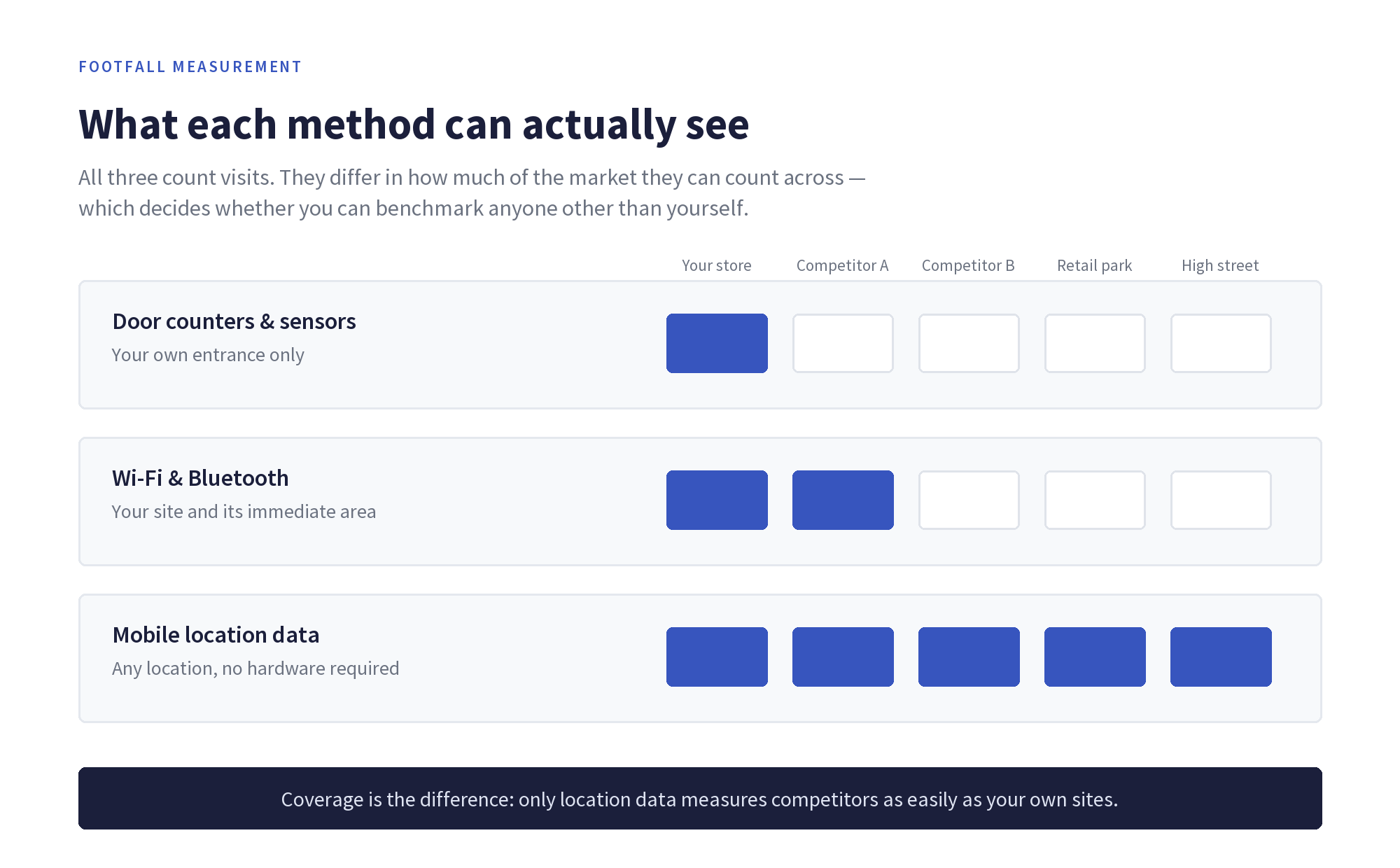
| Door counters and sensors | People crossing a threshold | Highly accurate at that door | Hardware per site; blind beyond the entrance; no catchment or competitor view |
| Wi-Fi and Bluetooth sensing | Devices with radios enabled nearby | Covers an area rather than a line | MAC address randomisation has eroded reliability; depends on radios being on |
| Mobile location data | A consented panel of devices, extrapolated | Works anywhere with no hardware; enables competitor and market-wide analysis | Measures a sample, not everyone; quality depends on panel and polygon accuracy |
The practical difference is coverage. Sensors tell you about your own doors. Location data tells you about everybody’s.
What accuracy actually depends on
“Accurate” is used loosely in this market. Four things genuinely determine whether a footfall figure is trustworthy.
Positional accuracy
Consumer location data varies from a few metres to a few hundred. In a retail park that difference is irrelevant. On a high street where three units share a frontage, data accurate to 100 metres cannot tell you which shop someone entered, and will confidently attribute visits to the wrong business.
The location boundary
Visits are counted against a point of interest boundary. A polygon drawn around a rough address rather than the actual premises is the most common cause of inflated numbers, particularly in shopping centres and dense retail where a sloppy boundary catches the pavement, the car park or the neighbouring unit.
Dwell threshold
Someone walking past is not a visitor. A credible methodology applies a minimum dwell time, and the threshold should suit the category: seconds distinguish a passer-by, but a coffee shop and a furniture showroom imply very different visit lengths.
Panel size and extrapolation
Mobile location data measures a sample and scales it up. That scaling is where most of the error lives. A vendor should be able to tell you panel size in the market you care about, how it splits between iOS and Android, and how extrapolation is calibrated — not just quote a global device count.
What it is used for
Site selection
Before signing a lease, footfall data shows how many people pass and stop, where they come from, and what else they visit. Catchment analysis turns a gut feel about a pitch into a measurable one.
Competitor benchmarking
This is the capability sensors cannot provide. Because location data does not require hardware at the site, you can measure a competitor’s visitation as readily as your own, and see whether a drop is your problem or the whole market’s.
Performance measurement
Refits, openings, new formats and trading changes all show up in visit patterns before they show up in reported sales.
Campaign measurement
Footfall is the outcome that offline advertising is ultimately trying to produce. Measuring it against a control group is the basis of visit attribution.
Footfall data: common questions
How accurate is footfall data?
It depends far more on methodology than on the raw data source. Positional accuracy, boundary quality, dwell thresholds and extrapolation each introduce error, and a vendor who cannot describe all four is not in a position to claim accuracy.
Can you measure a competitor’s footfall?
Yes, with mobile location data, because it needs no hardware at the location being measured. This is the main reason retailers and investors use it in preference to sensor networks.
What is the difference between footfall and visits?
Footfall is often used loosely to mean passing traffic, while a visit implies entering and staying. Any serious measurement counts visits using a dwell threshold, so the two are not interchangeable.
Is footfall data personal data?
The underlying location data usually is, and is governed by GDPR in Europe. Aggregated footfall counts are not, but the collection behind them still requires a lawful basis and valid consent.
Next steps
Footfall data is only as good as the boundaries, thresholds and panel behind it. If you are evaluating suppliers, ask about all four before comparing headline numbers — the figures are not comparable until the methodology is.
Our retail and real estate solutions set out how Tamoco approaches each, and our glossary entry on retail foot traffic covers the underlying definition.


James is the head of marketing at Tamoco

