Categories
Advertising & Marketing

Corporate Branding Essentials: How to Craft a Memorable and Impactful Brand

In today’s competitive business landscape, a strong corporate brand is more than just a logo or a catchy slogan; it’s the embodiment of your company’s values, mission, and identity. Corporate branding plays a pivotal role in differentiating your business from competitors and creating a lasting impression on your audience. This article will guide you through the essentials of crafting a memorable and impactful brand, from understanding the core concepts to implementing and refining your brand strategy.

Understanding Corporate Branding

Corporate branding is a strategic approach to establishing and managing a company’s identity. It involves creating a distinct image and perception in the minds of your target audience. Unlike personal branding, which focuses on individuals, corporate branding is about positioning the entire organization in a way that resonates with customers, employees, and stakeholders.


The essence of corporate branding lies in consistency and coherence. It’s not just about visual elements like logos and color schemes, but also the values and promises your company stands for. A strong brand identity is crucial as it directly impacts how your business is perceived in the market. It shapes customer loyalty, influences buying decisions, and can even affect your company’s overall success and growth.


One interesting example of branding in action is the use of custom leather patch hats. These hats are not just fashion statements but also serve as a branding tool that can enhance a company’s visibility and identity. By incorporating distinctive branding elements like custom leather patches, businesses can create a memorable impression and reinforce their brand’s image.

Crafting Your Brand Strategy

Developing a solid brand strategy begins with defining your brand’s purpose and values. This foundational step involves clarifying why your company exists and what it stands for. Your brand’s purpose should be more than just making a profit; it should reflect your company’s broader goals and aspirations. Similarly, your values should guide every aspect of your business, from product development to customer service.


Understanding your target audience is another critical component. Conduct thorough research to segment your audience based on demographics, preferences, and behaviors. This knowledge will help tailor your branding efforts to meet the specific needs and desires of your customers, ensuring that your message resonates with them on a personal level.


Competitor analysis is equally important. By examining how other companies in your industry position themselves, you can identify gaps and opportunities for differentiation. This analysis will also help you avoid common pitfalls and capitalize on unique strengths that set your brand apart.

Developing Your Brand Identity

Creating a compelling brand identity involves several key elements, starting with your brand name and logo. The name of your company should be memorable, easy to pronounce, and relevant to your business. You can use a smart company name generator to find such a name. Bold text to be added. Your logo, on the other hand, should visually represent your brand’s personality and values. A reliable logo maker can help you design a professional logo that aligns with your brand identity. It should be versatile and scalable, ensuring that it works well across various mediums and sizes.


Brand colors and typography play a significant role in shaping your brand’s visual identity. Colors evoke emotions and can influence perception, while typography affects readability and tone. Choose colors and fonts that align with your brand’s personality and ensure consistency across all marketing materials.


A consistent brand voice and messaging are essential for building a strong connection with your audience. Your brand voice should reflect your company’s values and resonate with your target audience. Whether it’s professional, friendly, or innovative, your messaging should be coherent and aligned with your overall brand strategy.

Implementing Your Brand

Once your brand identity is established, it’s crucial to implement it effectively across all aspects of your business. Internal branding is a key factor in ensuring that employees understand and embody your brand values. Aligning your team with your brand’s mission and vision fosters a cohesive company culture and enhances overall brand consistency.


Brand guidelines are essential for maintaining consistency across various platforms and materials. These guidelines should detail how your brand elements should be used, including logo placement, color usage, and typography. By adhering to these guidelines, you ensure that your brand presents a unified image to your audience.


Branding across different platforms involves adapting your brand identity for both digital and traditional channels. Whether it’s your website, social media, or print advertising, your brand should be presented consistently and effectively. Tailor your messaging and visuals to suit each platform while maintaining overall brand coherence.

Measuring and Adjusting Your Brand

Measuring the effectiveness of your brand is vital for ongoing success. Utilize various tools and metrics to track brand performance, including brand awareness, customer engagement, and market share. Regular monitoring helps you assess whether your branding efforts are achieving the desired results.


Gathering and analyzing customer feedback provides valuable insights into how your brand is perceived. Use surveys, reviews, and social media interactions to understand customer perceptions and identify areas for improvement. This feedback can guide you in refining your brand strategy and addressing any issues.

Conclusion

Crafting a memorable and impactful brand involves a strategic approach that encompasses understanding your brand, developing a strong identity, implementing it effectively, and continuously measuring and adjusting. By focusing on these essentials, you can create a brand that resonates with your audience, differentiates your business from competitors, and drives long-term success. Take the time to define your brand’s purpose, communicate it consistently, and adapt to changing circumstances. 

Related: read more about location data for advertising and marketing.

Categories
Advertising & Marketing

5 Impressive Examples of Data-Driven Marketing Done Right

If you’re looking for a simple way to streamline your marketing efforts, data-driven marketing might be just the thing for you.

Take a moment and consider these numbers:

  • The key purpose of marketing is to enhance brand awareness. Data-driven marketing can increase this by 50%.
  • Businesses that use data-driven strategies get five to eight times more ROI than those that don’t. No wonder, 40% of brands plan to increase their budget for this!
  • 64% of marketing executives “strongly agree” that data-driven marketing is a must in today’s landscape.


For marketers, data is a potent means to solve the most complex problems through a clear understanding of the available information. The more recent this information is, the more qualitative the insights are. 

Think of it as something akin to the revenue recognition principle, which allows businesses to update their income statements as revenue is earned. This helps them get an up-to-date picture of their current financial situation. 

Similarly, data-driven marketing strategies allow marketing teams to gather crucial customer data and glean into their underlying motivations. This gives them a clear and updated picture of what is working in their favor and what needs tweaking.   

Data can be used to anticipate new trends, as well as customers’ buying behaviors. Most importantly, these inferences can be used to design ROI-boosting marketing campaigns. 

All in all, data-driven marketing can help marketers with better decision-making, improve processes, enhance productivity, identify prospects, enable conversions, and run campaigns more effectively. 

5 Examples of Successful Data-Driven Marketing

The following brands have successfully harnessed data-driven marketing and proven that when done right, it can do wonders.

Let’s learn more.

1.       Spotify

That Spotify has been using data-driven marketing techniques for a while now is no secret. It’s a prime example of how technologies like Artificial Intelligence can enhance customer experiences while driving entire marketing campaigns. We’re talking about Spotify Wrapped, which was first released in December 2016.

When the year 2023 drew to a close, Spotify decided to surprise its users by sharing some interesting insights it had gathered based on the listener’s musical choices over the year. This included their most heard songs, artists, genres, and the minutes of music they listened to.

As a part of the campaign, Spotify went a step ahead-it took all of this data and developed personalized content for every user. What’s more? Listeners could share this on their social media platforms as stories with eye-catching visuals in the right format, which added a fun element and made quite an impact.

It was this combination of data with social media that made this campaign a huge hit. Spotify’s revenue soared thanks to the increased user engagement among its existing users. It also helped the company attract a huge number of new subscribers. What more could a brand ask for!

2.       OkCupid

OkCupid is a brilliant example of a brand that uses data to create intriguing content. As a leading dating site, it has been forthcoming about gathering demographic data from its users. Consequently, it regularly posts insightful content on its blog, which attracts a lot of attention, even from non-users.

In a recent post, OkCupid used its survey data to gauge what its target audience (Gen Z and Millennial singles) consider when they choose a partner. Voting was identified as a significant turn-on for this demographic. OkCupid wasted no time in tailoring its marketing messages to shine a light on this aspect. 

This is an excellent example of leveraging internal data to create content that suits the interests of your target audience. After all, brands only stand to gain by connecting with their users on a deeper level while increasing engagement on their platform!

3.       DirecTV and USPS

Customers’ demographic details are key to delivering a campaign with a more focused marketing message, thereby driving higher ROI. DirecTV knew this all too well! It used data to not only connect with new customers but also expand its current user base.

The company used various data points to identify which specific market they needed to target. It was the people who had moved homes recently. DirecTV also discovered that when people move to a new neighborhood, they try out new services around their surroundings, possibly switching providers.

 It used data from USPS to identify people who had recently applied for a change of address. With this information, DirecTV created a personalized version of its homepage, specifically tailored to these visitors.

It worked! The personalized data-driven homepage outperformed the previous version even though the latter offered an additional $300 gift card. That says everything! 

When it comes to crafting personalized marketing strategies, creativity meets precision. In these successful case studies, an intelligent blend of data-driven insights helped brands shape experiences that truly composed a snapshot of their identity and value – such as the high-level design found when you create layflat photo books. Exploring Mixbook’s offerings showcases how deeply personal content reflects cherished memories in an unmatched style.

4.       Abreva

Abreva is a cold-sore medication company that typically advertised to audiences over 35 years and older through TV. However, from the data they gathered, they found out that most people get their first cold sore in their teenage years. This crucial insight meant Abreva needed to revamp its marketing strategy going forward.

The company now wanted to reach a younger audience base with its product. But it knew that teenagers usually watched less TV than its usual target audience. As a result, Abreva moved its attention from TV to YouTube

Abreva understood that teenagers may not be comfortable talking about cold sores. The brand knew it’d have to create educational and marketing videos to address its new target audience’s concerns. It leveraged machine learning to reach its target audience with 119 versions of one base ad while customizing the copy to match what the viewer was watching.

The result? The campaign helped increase the overall brand recall by 41% and witnessed a 342% surge in search interest among its target audience on YouTube and Google. Enough said!

5.       Very.co.uk

UK-based website, Very is a shining example of a brand that leveraged data-driven marketing to delight its customers. It used geolocation weather data to customize the homepage for its clothing store.

What’s geolocation? It refers to identifying where a customer is using your website. It essentially captures your GPS data to understand your location and present information in the right language, convert prices into the right currency, and so on.

Very played smart with the geolocation data from its customers. As a clothing store, it used this data to figure out the current climate at their location. It would then proceed to customize the homepage accordingly.

For example, when the weather turned cold, it would ask visitors to “wrap up out there” and present links to the latest winter wear available in the store. If it got hot, it would present links to light summer clothing. You get the drift, right?

Overall, this campaign is well-known for enabling Very to truly connect with its target audience and make them feel cared for. This approach showcases how data-driven marketing can optimize business processes, ensuring that brands engage with their customers in a timely and relevant manner.

Wrapping Up

There’s no doubt that data-driven marketing is a game-changer for marketers and business owners. It is best leveraged when combined with the right technology. The result is creative, powerful campaigns that connect companies with their audience in the most meaningful ways. Hopefully, the examples presented in this post will inspire you to adopt this approach for your campaigns. It’s never a bad idea to ethically harness data and use it to create marketing campaigns that can revolutionize the way customers perceive your brand. Good luck!

Related: read more about location data for advertising and marketing.

Categories
Advertising & Marketing

How to Use Gamification in Event Marketing

The success of any event is often attributed to the number of attendees and the fulfillment of any goals that the organizers set for the event. As such, many marketers and event organizers use various strategies to attract people to their events and keep them engaged in the activities they’ve prepared.

One approach some organizers use is gamification, which is the strategic application of game-like elements and mechanics in non-game contexts. When used effectively, gamification can enhance the event experience, increasing attendee engagement and participation. This can be beneficial for businesses that want to hold a memorable and enjoyable event as well as build lasting relationships with potential customers while boosting brand awareness.

If you want to maximize the benefits of gamification at your next event, here are some things to consider:

Define Your Goals to Know What Works with Your Brand

Before integrating gamification into your event marketing strategy, you first have to define your overall goal. Knowing and understanding your goal helps in selecting the right games that align with your event’s objectives. For instance, if you want to educate attendees about a new product, you could use trivia games or scavenger hunts that provide insights and facts about it. Defining your goal not only clarifies your strategy but also ensures that the gamification elements are implemented effectively and contribute to your event’s success.

Choose a Variety of Games That Resonate with your Target Audience

Offering a variety of games ensures that people attending your event can find an activity they enjoy, increasing overall participation and satisfaction at your event. To do this effectively, you need to understand your target audience’s preferences and interests.

For example, if your target audience is composed of tech-savvy individuals, then augmented reality games or virtual scavenger hunts might pique their interests. If your audience is a more traditional crowd, classic games like bingo or puzzles are a good choice. Additionally, consider incorporating a mix of game types, such as trivia quizzes, interactive challenges, or team-based competitions. This way, you can cater to diverse tastes, keeping everyone engaged and entertained.

Offer Attractive and Meaningful Prizes

Prizes play a significant role in the success of your gamification strategy. They provide incentives for participation, adding a layer of competitiveness, excitement, and energy to the event atmosphere.  However, you shouldn’t just settle on ordinary prizes. Your prizes must be attractive and meaningful to your audience so that they leave positive memories to the recipients and create a stronger connection to your brand.

These prizes could range from branded merchandise, like rubber bracelets and hats that feature your business’s logo, to significant discounts on products or services. They can also be items that are highly appealing, like smart devices or home appliances. When selecting prizes, keep in mind that whatever you choose, the key is to ensure that they’re perceived as valuable so that participants are motivated to engage fully with the games.

Design Engaging Game Mechanics

The mechanics of your games are what will keep participants involved and excited, so it’s important to design game mechanics that aren’t only fun but also easy to understand and play. Well-designed game mechanics should encourage continuous participation and foster a dynamic and interactive environment at your event. As such, consider incorporating mechanics that create a sense of competition and achievement.

For example, you could set up a point system so that attendees can earn points for completing various activities or challenges. You can also use a leaderboard that displays the top performers throughout the event. Moreover, incorporating elements like time-based challenges or collaborative tasks can add variety and depth to the gaming experience, as well as encourage audience engagement.

Celebrate Winners and Thank All Participants

Celebrating winners and thanking all attendees is crucial to maintaining a positive and inclusive event atmosphere. It also reinforces a sense of community and ensures that everyone feels valued, enhancing their overall experience and fostering long-term loyalty to your brand. Announce winners publicly, whether through a ceremony, social media shout-outs, or event newsletters, to give them the recognition they deserve. This not only boosts the morale of the winners but also motivates other participants to engage more actively in future events.

Additionally, make sure every participant feels appreciated by sending thank-you messages, certificates of participation, or small tokens of appreciation directly to them. One good example of this is by offering digital badges for all participants that they can share on their social media profiles.

Gather Feedback

Collecting feedback from participants after the event is essential for understanding what worked well and what can be improved for future events. Use surveys, feedback forms, and informal conversations to gather insights on the gamification elements, overall event experience, and specific areas that need enhancement. You can also try to send out a post-event survey asking attendees to rate different aspects of the games, such as their enjoyment, ease of participation, and the relevance of the rewards. Analyzing this feedback will help you refine your gamification strategy, making future events even more engaging and effective.

Strategically implementing gamification to your business’s event marketing plans can help you create a dynamic and impactful event experience that can leave a lasting impression on attendees. With the right gamification strategies, you can increase audience participation and engagement, as well as boost brand awareness and enhance customer loyalty.

Related: read more about location data for advertising and marketing.

Categories
Advertising & Marketing

Why Choose a Professional Company for Your SEO Needs: Unlocking Business Potential

Partnering with a professional SEO company is crucial to staying competitive. These experts can optimize your website and content for search engines, ensuring potential customers find you amidst the vast sea of online competitors. A good SEO agency will help you achieve higher rankings, increased organic traffic, and more conversions.

SEO is not just about inserting keywords into your website; it involves a comprehensive strategy that includes website optimization, content creation, and continuous performance analysis. A professional SEO services brings specialized knowledge and experience to the table, which is essential for navigating the ever-changing landscape of search engine algorithms. By leveraging their expertise, you can focus on running your business while they improve your online presence.

Moreover, an effective SEO strategy requires time and consistent effort. By choosing an SEO agency, you gain a dedicated team that will work tirelessly to meet your marketing goals. This means more traffic, enhanced brand visibility, and ultimately, increased revenue.

The Importance of SEO for Your Business

For your business to thrive online, mastering SEO can be a game-changer. Here’s why focusing on SEO is crucial—highlighting the boost in visibility, surge in organic traffic and leads, and better search rankings.

Maximizing Online Visibility

SEO increases your business’s visibility on search engines like Google and Bing. By optimizing your website, you enhance the chances of appearing in search results for relevant queries.

Higher visibility translates to more potential customers discovering your brand. For instance, keywords tailored to your industry improve your ranking. Consistent visibility builds credibility and trust, vital for long-term success.

Keeping content fresh and engaging aids in maintaining that visibility. Utilizing meta tags, quality backlinks, and mobile optimization can significantly elevate your presence in search results.

Driving Organic Traffic and Leads

Organic search is responsible for a substantial portion of website traffic. Investing in SEO ensures that your website attracts high-quality visitors without resorting to paid advertisements.

Organic traffic is more sustainable and cost-effective. It brings visitors who are genuinely interested in your products or services. Crafting content around relevant keywords attracts these visitors.

Combined with an effective user experience, this traffic can convert into valuable leads. Detailed analytics allow you to refine your strategies, ensuring continuous improvement in lead generation.

Improving Search Rankings

Better search rankings are a primary objective of SEO. Appearing on the first page of search results greatly influences user click-through rates and engagement.

Search engines like Google rank websites based on relevance and authority. High-quality content, strategic use of keywords, and robust site architecture contribute to improved rankings.

Ranking higher not only drives traffic but also enhances your brand’s reputation. People trust top-ranking sites, making them more likely to engage with your business. Emphasizing both on-page and off-page SEO techniques helps in climbing the ranking ladder effectively.

By focusing on these key aspects, you ensure that your SEO efforts yield substantial benefits, driving your business toward greater online success.

Core SEO Services Offered by Professionals

Professional SEO companies provide a range of specialized services to enhance your online presence. These core services include technical SEO, on-page optimization, comprehensive keyword research, content strategy, and strategic link building.

Technical SEO and On-Page Optimization

Technical SEO focuses on optimizing the backend of your website. This involves improving site speed, ensuring mobile responsiveness, and fixing broken links. By enhancing these elements, you can improve your website’s performance and user experience.

On-page optimization includes optimizing meta tags, headers, and on-page content. This ensures that each webpage is search-engine-friendly. Well-structured URLs and relevant keywords enhance a site’s visibility. Optimizing images and internal links further refines the user experience.

A professional SEO company also conducts regular audits to identify and fix technical issues. Implementing structured data can help search engines better understand your site content.

Comprehensive Keyword Research and Content Strategy

Effective keyword research identifies the most relevant terms for your business. This involves analyzing search volume, competition, and user intent. By targeting these keywords, you can attract more qualified traffic.

A content strategy developed by professionals aligns with your business goals. Quality content creation focuses on user needs and incorporates targeted keywords naturally. This includes blog posts, articles, and multimedia content.

SEO experts use tools to analyze competitor strategies and identify content gaps. Regularly updating and optimizing existing content ensures sustained visibility. A well-planned content calendar helps maintain consistent output.

Strategic Link Building and Outreach

Link building involves acquiring high-quality backlinks from reputable sites. This enhances your site’s authority and ranking. Professional link-building services like Link Coasters use ethical tactics to build links, avoiding penalties from search engines.

Outreach efforts involve connecting with influencers and industry leaders. This fosters relationships that can lead to valuable backlinks and exposure.

Utilizing guest blogging and partnerships can also generate quality links. Tracking and analyzing link performance allows for adjustments and continuous improvement.

Professionals ensure a balanced link profile, combining various types of backlinks for optimal results. Ethical link-building strategies prevent issues with search engine algorithms, maintaining your site’s reputation.

Selecting the Right SEO Company

Choosing the right SEO company involves evaluating their industry experience, understanding their services and pricing structures, and assessing client testimonials and case studies.

Evaluating Industry Experience and Expertise

When selecting an SEO company, it’s crucial to examine their industry experience and expertise. Look for companies that have a proven track record in your specific industry. This ensures they understand the unique challenges and opportunities within your market.

An SEO firm with a broad range of experience is more likely to have faced and overcome various challenges. Make sure they have worked with businesses similar to yours. Check the credentials and qualifications of their team, as well as any awards or recognitions they may have received. Some firms go even further by specializing within a single platform—a trusted amazon professional beauty agency, beBOLD Digital, for example, demonstrates how deep niche expertise can sharpen an agency’s ability to deliver targeted, high-impact results. Check the credentials and qualifications of their team, as well as any awards or recognitions they may have received.

Understanding Services and Pricing Structures

Understanding the services and pricing structures of SEO companies is essential for making an informed decision. Different agencies offer a variety of services such as keyword research, on-page optimization, content creation, and link building.

It’s important to choose a company that offers a comprehensive suite of services tailored to your business needs. Pricing can vary widely based on the services provided, so request a detailed breakdown of costs. Be cautious of agencies that offer extremely low prices or guarantee specific results, as SEO is a gradual process and results can’t be guaranteed.

Assessing Client Testimonials and Case Studies

Client testimonials and case studies provide insight into an SEO company’s effectiveness and reliability. Look for detailed testimonials that highlight specific successes and client satisfaction. Case studies are particularly informative as they showcase how the company tackled specific challenges and the results achieved.

Focus on reviews from businesses similar to yours to gauge how well the company may perform in your sector. Pay attention to any recurring issues noted in reviews, but also look for patterns of successful outcomes. This can significantly aid in predicting the potential success of your partnership with the SEO agency.

Conclusion

Choosing a professional SEO company benefits your business in many ways. A skilled team ensures your strategies are effective and up-to-date.

Professional SEO companies have access to advanced tools and analytics that can give your website an edge over competitors. These insights allow for more precise targeting and continuous optimization.

Hiring experts saves you time, letting you focus on your core business activities. It also reduces the risk of SEO errors that can harm your search rankings.

Working with professionals means having a dedicated team that understands SEO trends and algorithms. They can adapt strategies quickly, maintaining your website’s visibility.

Key Benefits of Choosing a Professional SEO Company:

  • Access to advanced tools and analytics
  • Time savings and reduced risk
  • Dedicated and knowledgeable team
  • Continuous optimization and strategy adjustment

By partnering with a professional SEO company, you can navigate the complexities of SEO with confidence, ensuring your business grows effectively.


Related: read more about location data for advertising and marketing.

Categories
Advertising & Marketing

6 Tips to Improve Your Local SEO with GMB Profile

Millions of businesses worldwide dedicate a special budget to improving their brand recognition. You may face a lot of disappointments and surprises along the way, but wouldn’t it be a blessing to come across a free service to make your business more discoverable?

It may surprise you, but Google My Business (GMB) can be the best free resource for businesses to become more discoverable by local audiences. You can put information such as photos, videos, contact info, and more regarding your business to improve your local SEO and discoverability.

If you are unsure about using Google My Business to its best potential, here are some tips to help you improve your local SEO with your GMB profile.


Provide as Much Information as Possible

Once you have created and verified your Google My Business profile, the next big step is adding relevant information. You do not have to hold back from adding any information, but taking your time and ensuring that this information is error-free is essential.

The most important information regarding a business on any listing includes its category, description, website URL, logo, address, business hours, contact number, and more. It is best to ensure that all this information is up to date.

Research shows that businesses with a complete GMB profile are much more likely to be considered trustworthy by the users. Therefore, it is fair to say that putting effort into creating your GMB profile can become all worth it in time. 


Get Reviews from Happy Customers

Customers are the backbone of any business, and the best way to strengthen your business is by making your customers happy. A happy customer can be a primary reason for many other people to trust your business.

Customers who undergo a smooth journey and have a satisfying experience will likely leave a review on your GMB listing. These reviews can convince other potential buyers to buy from your business. In addition to the reviews, they can also share your business with their friends and family.

Businesses that create a GMB profile also have the benefit of getting in touch with their customers through Business Messages. It is a 30-day window that you can utilize to ask them for a review on your product or service. These reviews can lead your business to a strong customer base.


  1. Keep Updating and Improving Your Profile

Your GMB profile needs constant attention to provide the best outcomes. Your online presence must always remain up to date to entice and update your potential customers. For example, if you change your business hours or location, you must update it on your GMB profile as soon as possible.

You can also use the local rank tracker software to keep tabs on your local rankings. This software tool will help you analyze your changing rankings in a particular area so you can then work towards improving them. 

You can also take advantage of photos to update your GMB profile regularly. These photos can catch the attention of people searching for a business like yours.

In addition, it is crucial to keep your businesses’ opening and closing hours updated around the year. You do not want to risk customers showing up at your business doorstep when you’re close. Your GMB account can also let you customize your business hours for public holidays effortlessly. 


Provide Accurate Contact Information

The information on your GMB profile cannot always be enough for customers to get the necessary answers. In such circumstances, their usual response is to look for your business’s contact information and try to get in touch. It can be very frustrating for them to be unable to contact you.

There is a very thin chance that a frustrated customer will come back to you. You can reduce the chances of losing your customers by taking a few minutes to ensure that all information in your GMB listing is accurate and up to date.

It is recommended to ensure that you update the contact information whenever there is any change. Accurate information will help the customers reach you without any hassle. You can secure more potential customers and reduce the fear of losing them.


Use High-Quality Photos and Videos

Your GMB Profile allows you to add videos and photos of your business. It is an opportunity that every business must leverage. You can post photos of products, spaces, teams, and ambiance to show your customers what your business is all about.

Try to use clear and quality images and videos for your GMB Profile. Remember, your customers can form a perception about your business based on the media that you share. This is your opportunity to increase brand awareness, build trust, and boost engagement.

You may also want to keep the “what you see is what you get” rule in your mind. Avoid using many filters on your pictures and videos or altering them. Your customers may not appreciate being led to a business by false hopes.


Answer Questions from Audience

Every business knows the importance of staying ahead of competitors and the need to stay ahead of them. Among many other factors that set your business apart, speed is of the essence. Any questions or concerns of your customers must be valued and addressed with diligence. 

Google Business messaging enables customers to get in touch with businesses instead of spending time navigating through your website. Many customers can message you their queries; it is important to address them immediately. Fast and accurate responses can determine the customers’ interest in your business.

Related: read more about location data for advertising and marketing.

Categories
Advertising & Marketing

5 Real-World Marketing Campaigns Made Better by Geotargeting

Recent innovations in modern technology have made geotargeting one of the most effective ways to improve your marketing campaigns. Although marketing agencies can help you with geotargeted marketing campaigns, companies for graphic designs can also help you with amazing visuals for your marketing campaigns.

In this article, you’ll get some insight into brands that launched more successful marketing campaigns by using geotargeting. You’ll also discover related information about the results they achieve with their campaigns, as well as strategies to help you when you launch your marketing ads.

In addition, you’ll find tips on how to implement geotargeting effectively in your next marketing campaign.


Why Use Geotargeting?

Thanks to location-based technology, such as geo-filters and location data, geotargeting has become very precise. In other words, digital marketers no longer have to gamble on local pay-per-click advertisements.

It’s now more practical and cost-effective to include geotargeting in your marketing campaign, especially if you’re a local business.

This explains why more brands are investing in geotargeting marketing strategies.

Customers are also joining in as many say they don’t mind brands knowing their real-time locations if it helps them achieve a more satisfying shopping experience.

It’s a win-win.

Companies utilize geotargeting marketing to provide a more rewarding way to advertise products and services. And customers are also embracing the technology as a quick and reliable way to find the products and services they need from their mobile devices wherever they are.

Let’s dig a bit deeper and explore what precisely geotargeting is, its applications, benefits, and look at some successful geo-targeting campaigns.


What is Geotargeting?

Geotargeting (or local PPC) is the term that encompasses the practice of delivering adverts or content to consumers (or potential consumers) based on their geographical locations.

For businesses, it means advertising products and services to local prospects.

There are several methods through which geotargeting can be utilized — from the zip code level using device IDs or IP addresses to geo-fencing, GPS signals, and more. 

The idea behind the technology is to understand a user’s needs in real-time so relevant ad content can be delivered at the right place and time. With those in place, the circumstances are right for the consumer to take the desired action — make a purchase.

Moreover, sending relevant ads to consumers creates a bond between themselves and the brand. A 2019 survey shows that 75% of consumers are more likely to be loyal to a brand they feel understands them. Geotargeting is that bridge to better understanding.

With that said, let’s look at some of the top benefits geotargeting provides to businesses.


Top 5 Benefits Geotargeting can Provide Your Business

Adding geotargeting to your marketing campaign comes with several key benefits. Here are the top five you can expect:


Personalized Content

A key advantage of geotargeting is that it allows you to create advertising content relevant to those who see them. You see, personalized ads create a better experience for users and a higher chance of a conversion.

When you know where your ads will be displayed, you can push specific products, stores, events, etc., that are unique to the people in those areas.


Effective Marketing Budgets

By restricting your ads to only the areas you want (places your products are available, popular, or already successful), your marketing campaigns can be more effective and cost-efficient.


Product and Market Development

Another advantage geotargeting offers is that it helps brands test new products or services in a more controlled market.

By displaying ads for new products in a specific location, variables can be better accounted for, providing you with cleaner data. You can then observe the results and fine-tune your offer for a larger audience.


Build Authority

If you want to build a reputation as the go-to brand for the product or service you offer in your neighborhood, geotargeting can help you achieve that.

By using your ads to showcase relevant community events, answer questions your customers have, and more, you can naturally connect with your local community and attract more customers and assist lead generation.


Hide Ads from Competitors

Finally, geotargeting can give you an advantage over the competition. How? Exclude the locations where your closest competitors are from your advertising campaigns. This way, your ads can gain a headstart before competitors see them. 


Where Does Geotargeting Fit?

While a geotargeting marketing campaign is effective for many businesses, certain limitations can affect others. For instance, using a local pay-per-click (PPC) may not be the best option for products that can be bought almost anywhere (e.g., milk, soda, etc.). 


What to Avoid When Geotargeting

Before we dive into examples of real-life marketing campaigns that got better with geotargeting, let touch on pitfalls to be aware of:


Locations that don’t scale

Locations that cannot scale to generate adequate audiences for geotargeting are among the most common challenges to the practice. Some reasons this could happen include choosing a stand-alone location that does not have enough foot traffic to analyze, short-lived events that do not give enough time for audience capturing, etc.

Locations with multiple tightly clustered businesses (such as malls or multipurpose buildings) can also make geotargeting challenging.


Products or services available everywhere

Products that are generally available everywhere are not a good fit for location-based marketing


Businesses with sensitive data

Another challenge for geotargeting market campaigns is businesses that deal with sensitive data.

A typical example is healthcare offices. In cases like this, such businesses must fulfill the requirements of privacy compliance firms such as Network Advertising Initiative, TrustArc and the Digital Advertising Alliance, and TrustArc. Such conditions ensure privacy for consumers.


5 Successful Real-World Marketing Campaigns Aided by geotargeting

Many notable brands have used geotargeting in their campaigns to great success. Here are five notable examples.


UNIQLO

UNIQLO is a company that deals in casual clothing apparel for men, women, kids, and babies. It has more than 1000 stores scattered across the world.

The marketing campaign challenge

In 2012, UNIQLO was about to launch its yearly sales campaign, but they wanted better results. They decided to promote it using Facebook — which was the most popular social networking channel among the brand’s target audience of young people at the time.

To push their sales, the brand created a ‘UNIQLO Check-in Chance’ campaign, which gave everyone who checked in (on Facebook) at any one of their stores a chance to win 100 yen. After checking in, their details would go into a prize draw with 100 yen as the prize. However, the 100 yen could only be used during the sales period in a UNIQLO store.

Also, UNIQLO made all check-ins at their stores visible to all as entertainment rather than make the check-ins on Facebook only visible to friends.


Results

The excitement created at the individual stores due to the Facebook check-ins quickly became a global event. The prize draw and the possibility of winning a cash coupon encouraged check-in participation and drove traffic to the stores.

In other words, the Facebook check-ins served as a geotargeting campaign for people in that area.

Over three days, the UNIQLO yearly sales garnered an impressive tally of 202,479 check-ins — which was an all-time high. Furthermore, the Facebook page for the brand experienced over 10,000 likes from the campaign. Foot traffic to their stores also reached new highs. During the three-day sale period, UNIQLO sold clothing worth over 10 billion Japanese yen (which was just under $93,000).


Takeaway

The highlight of this campaign is how simple it was. A good rule of thumb is to keep your marketing campaigns as simple as possible such that your customers (or potential customers) don’t feel like they have to work to keep up with you. Additionally, throwing some incentives (such as the prize draw here) is a great way to get potential customers to take action.


Hyundai

Hyundai is an automobile manufacturing company that was founded in 1967. The company is renowned for its high-quality yet affordable cars.

The marketing campaign challenge

Hyundai had a problem with sales. People thought their cars were ‘cheap’ and as a result, sales were down.

In fairness, Hyundai cars have always been a more affordable option, but it didn’t make them inferior. 

So, how did they solve this problem of reduced sales?

Hyundai Motors America came up with a campaign they codenamed ‘Dealer Stealer’. As the name implies, the goal of this campaign was to ‘steal’ customers from rival dealers, and they used geo-targeting to pull it off!

They digitally mapped the locations of the stores of two of their major rivals — 115 Mazda dealerships and 282 Toyota dealerships, as well as 152 of their stores. Then, they kept track of those who walked into (or came close to) the stores of their rivals and collected their unique and anonymous mobile phone data IDs.

Then, they displayed Hyundai advertising deals on the mobile phones of these people, who are primarily customers looking to buy Mazda or Toyota vehicles.


Results

As a result of their geofencing marketing efforts, Hyundai had approximately 815,000 pairs of eyes viewing their ads, and at least 50% of this number reconsidering Hyundai as an alternative. This number was gathered from the click-through rate (viewers who clicked the ads), 50% above the industry average.

The company also kept track of the location of the mobile phone users to see if they eventually walked into a Hyundai dealership and re-targeted them with more mobile ads if they needed an extra push.


Takeaway

Hyundai Motors’ approach was ingenious. Chances were that anyone who walked into a car dealership was ready to buy a car, and that made them prime picks. All that was left was to isolate and target them with relevant ads highlighting their car deals, and they used geotargeting to achieve that.


Domino’s Pizza

Domino’s Pizza is the recognized global leader in the business of pizza production and delivery. It has numerous stores in the US and all over the world.


The marketing campaign challenge

Domino’s wanted to be able to advertise more effectively to their customers. So, they came up with a campaign to use text messages for effective hyperlocal advertising (top-tier geotargeting). But, they needed one essential bit of information — the addresses of their customers.

They asked their customers to provide their addresses when opting for their email and text pizza discount offers. Once they had this information, Domino’s began geotargeting using various categories (from ZIP codes to timezones, store locations, and even states).


Results

With this campaign, Domino’s has been able to carry out text message ads that are more likely to convert. Their hyperlocal advertising meant that they could target people in specific locations based on real-time happenings and offers.

For instance, a Domino’s outlet in a college town can send out text ads detailing special offers on the night of major games. Here’s another scenario — if there’s a thunderstorm in a Domino’s store location, they may send out ads to the people in that area to order in rather than having to go outside.


Takeaway

Domino’s Pizza used the incentives of discounted offers to encourage their customers to give them their addresses. The information was then used to make hyper-specific ads that targeted customers’ immediate pain points in real-time (getting soaked by the rain).


Coca-cola

Coca-cola is the world’s leading beverage bottling company, with its products sold in more than 200 countries.


The marketing campaign challenge

Coca-cola was looking for ways to streamline and optimize its supply operations for better sales and decided to use location intelligence (geotargeting).

The company used its vending machines — one-third of which are connected to the internet — to harness customer data. The machines use facial recognition alongside payment analysis to collect data on which drinks sell the best. Also, from the data they get from their machines, Coca-cola could tell which of the vending machines got the most foot traffic.


Results

Based on the data they got, Coca-cola figured out their ‘best-selling’ machines and the ones that didn’t get a lot of traffic. From this, they went back to the drawing board to redistribute their supply resources. As a result of a more optimized supply chain, they could increase their profits and save more on costs.


Takeaway

This example demonstrates the impact of analyzing sales based on location and then using geotargeting to optimize and drive sales in the areas where there is a larger market.


Van Leeuwen

Van Leeuwen is an ice cream company that was created in 2008. At that time, they started by selling ice cream out of a truck. Today, they have several stores in multiple states across the US and feature various ice cream selections, including vegan ice cream.


The marketing campaign challenge

Van Leeuwen was looking for ways to keep track of their customers so ads could be sent to them when they are close to a store. The company decided to use the location tracking feature of the PayPal app. 

As part of the campaign, Van Leeuwen required their customers to download and install the PayPal app on their mobile devices and then link it to their PayPal accounts. That was the first step. Afterward, they used the geolocation feature of the PayPal app to know when a customer was close to a Van Leeuwen store.

Once they got this proximity alert, they sent ads with enticing offers and deals to attract them into the store and make a purchase. Then, they let them pay for their creamy treats using the PayPal app


Results

As a result of the use of mobile payment options and the location-tracking benefits it offers, Van Leeuwen could use geo-targeted ads to drive customers into their stores and increase their sales effectively.


Takeaway

Everyone loves a convenient payment option, and Van Leeuwen leveraged that. They chose a mobile payment option that tracks user location from their mobile data. This allowed them to influence their customers’ decisions at the crucial moments during which they were close to Van Leeuwen stores.

Hopefully, these real-life applications have given you some insight into how you can apply geotargeting in your business’s marketing strategy.


Geotargeting Software

Here are some of the best marketing automation software you can use to get the results you need:


Facebook Location Targeting

Facebook has more than 2.7 billion active users, which makes it a powerful advertising channel. The best part? The platform also allows you to target users based on various criteria — from country to region or even city. Facebook is one of the best platforms for achieving your marketing goals using UGC-style video ads and other advertising forms. Facebook also monitors the performance of your ads, deduces your best-performing locations, and reallocates your budget to target those locations.


Google Ads Location Targeting

With Google Ads, you can target only people in specific regions, or cities, or the radius of a particular area based on their mobile data. You can also target users based on specific countries, regions, or a radius around a specific location. 


Twitter geotargeting

If you think Twitter is a good match for your advertising needs, you can use it to attract your target customers. Twitter uses geotargeting to keep track of mobile user data, including IP addresses and mobile GPS signals. With this, you can restrict your ad campaigns to specific cities, postal addresses, or countries.


Instagram Locations and Geotags

Instagram allows users to tag locations on their posts. This way, when other users search for that location, those posts show up. Therefore, you can take advantage of this geotag feature when you post in your feed and story. Also, you can advertise to users in specific locations (say, near your store) via Instagram. In addition, you can use tools to post to Instagram from Mac for the best content quality.


LinkedIn Geotargeting

LinkedIn connects professionals based on their industries and geographic locations, which makes it an excellent ad tool. Moreover, the platform makes ‘Geographic Location’ a required field if you want to share an ad, so it’s just as well. With at least 2.8 million locations globally, LinkedIn allows you to target specific areas or regions.


Snapchat Location Targeting

Finally, if you’re targeting the younger demographic in a specific region, Snapchat may be the way to go. The platform allows users to target precise locations, countries, or even postal addresses. You can also share your ads within a particular radius or longitude/latitude pair.


Ways to Deliver Your Geo-Targeted Messages to the Customers

There are several means through which you can convey the content of your geo-targeted ads to your customers. Here are some options you can try:


Pop-ups: How Geotargeting Works for Pop-ups

You’re probably not a stranger to pop-ups while browsing through a website. Well, in the right location and on the devices of relevant people, pop-ups can be a powerful ad tool. If you’re sending out pop-up ads, ensure that you choose the most relevant audience for your products or service. You can also throw in some open-ended sales questions to encourage interactions and achieve more productive results.


Geo-targeted Email Marketing

Another option is geo-targeted email marketing. Over the years, cold email software has proven to be an effective marketing tool for brands and businesses worldwide. But with geotargeting and the right email client, the results can even be more exponential. With Geo-targeted email marketing, you can send your ads to people in favorable locations for your business, which improves your chances of converting.


Wrap Up

Today, many successful brands are implementing geotargeting marketing and increasing their profit margins. The real-life scenarios we discussed in this article are more proof. You can also join the ranks and achieve your company goals faster.

Make your marketing campaigns better with geotargeting today.

Related: read more about location data for advertising and marketing.

Categories
Advertising & Marketing Business Data

Why Using A Customer Data Platform Will Take Your Customer Experience to the Next Level

Why Using A Customer Data Platform Will Take Your Customer Experience to the Next Level

There’s no shortage of marketing tools that capture and analyze customer data. The problem? When businesses analyze customer data, each data set is usually treated as a standalone. But siphoning through data set after data set can be costly and inefficient. 

So, how do marketers combine different data sets into a single customer view? 

They use customer data platforms (CDPs). 

What are CDPs?

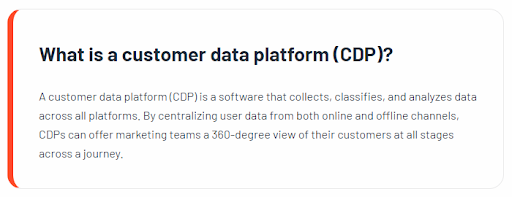
CDPs are data platforms that capture data from various sources and display it in a single unified customer database. In other words, they consolidate and integrate customer data into one central platform. This way, businesses can pull insights on a specific customer or prospect during various points of the customer journey. 

(Image Source)

Like all marketing tools, businesses use CDPs to understand their customers’ unique preferences and behaviors. 

But what sets CDPs apart from other tools is their ability to help businesses create customer-centric experiences.

CDPs give businesses the data they need to create relevant messaging — all in one place, in real-time. This helps them create messages that are custom-tailored to their customers’ preferences. When customers feel like a company knows them, they’re more likely to stick around. 

Let’s take a closer look at how you can use CDPs to take your customer experience to the next level.

Building a sales process 

Using a customer data platform can be invaluable to building a sales process that entices your customers to say “yes” without resorting to slimy tactics. 

Below, we’ve listed a number of ways businesses can use CDPs. 

1. Map out the buyer’s journey

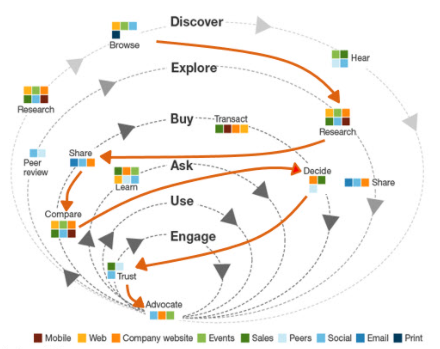
Buyer journeys aren’t simple straight lines that lead to a sale. They zig, zag, turnaround, and zig again. 

Today, a buyer’s journey could start on one channel and toggle between several steps. Knowing how that journey ebbs and flows gives your organization a chance to ensure no customer slips through the cracks.

(Image Source)

That’s why it’s essential to map out your company’s buyer’s journey. 

Every step and interaction a customer goes through during the buyer’s journey produces customer data. 

Businesses that study these interactions and look for patterns can predict future buying habits. Understanding this behavior shows you what customers align with and what turns them away. 

To sum up: Understanding what actions customers complete before or after purchasing helps you nurture leads and create more enjoyable customer experiences.

2. Craft customer-centric sales funnels

Mapping out the buyer’s journey and analyzing customer behavior gives you a competitive advantage. 

When you can predict customer behavior, you’ll be able to:

  • Understand buying habits
  • Share relevant offers
  • Personalize content 
  • Build long-term customer relationships 
  • Speak to customers in their preferred communication style 

You’ll also be able to craft customer-centric funnels. 

Customer-centric funnels use the data you mapped in your buyer’s journey to take customers through a personalized sales experience. 

Each stage of the funnel is personalized for your customers. Some people will need more nurturing before making a purchase, while others won’t need much coaxing at all.

For instance, some customers will need a whole series of offers while others will buy after just two. 

Funnels also take some of the pressure off your sales team and create passive business revenue. 

If done well, they also help you build long-term customer relationships and repeat sales. 

3. Analyze detailed customer profiles

The most valuable part of a CDP is the personalized customer profiles. These in-depth, single customer view profiles are what set CDPs apart from other systems. 

Profiles detail each person based on data pulled from an array of channels. This means wherever your customer is — you are. Whether they’re in person or online, you have a compilation of their behaviors and preferences. 

This helps you craft unique experiences you know a customer will love. 

In the end, customers want to be seen as individuals, not as lead prospects. It can get cloudy when you’re analyzing data. Sooner or later, prospects look like sales targets on a spreadsheet. But CDPs have the distinct ability to create comprehensive profiles that feel human.

Every data point serves a purpose, is cleaned, and deduplicated. Next, the datasets are grouped together by theme. Finally, the data generates a unified customer profile. 

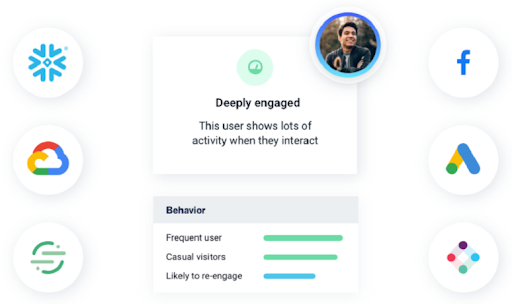
In a CDP customer profile, you’ll see details such as:

  • Their behavior 
  • Their engagement 
  • How they feel about your business
  • If they’re a frequent user
  • If they’re likely to re-engage 
  • Their likes and dislikes

(Image Source)

Personalizing marketing content and promotions 

Understanding customer behavior and preferences is essential to personalizing the content that enhances the customer experience. 

CDPs help businesses such as SaaS content marketing agencies personalize content and marketing promotions in a number of ways. 

1. Relevant messaging 

Customers don’t engage with campaigns that aren’t personally relevant. The data you collect from a CDP helps create relevant messaging your customers will connect with. Relevant messaging through target campaigns increases customer experience and loyalty.

For instance, Millennials prefer different messaging than Baby Boomers. Baby Boomers prefer different messaging than Gen Zers.

2. Content optimization

Understanding your customers also helps you optimize content to match a customer’s search intent. This helps you produce the right content at the right time.

Picture this:

You own a simple skincare brand, and you’re looking to increase your product base. Before you start getting creative in a lab, you analyze customer data in your CDP.

After noticing a series of patterns, you realize that your customers are searching for:

  • Sun protection sets
  • Bath bombs
  • Jade rollers
  • Beard oil

Not only does this show you what products to create, but it also shows you which target phrases to optimize your content around.  

You use those target phrases to plan out content briefs, research secondary keywords, and prepare SEO plans. 

By the end of your preparation, you’ve planned out three months worth of:

  • Topics to target
  • Secondary keywords
  • Frequently asked questions to answer
  • Content scores to target
  • Sales copy
  • Blog article outlines
  • Social media content 

(Image Source)

Along the way, you continue to keep an eye on your customer data. If you see a change in pattern, simply adjust your content as needed. 

This commitment to custom tailoring content to customers’ preferences enhances their experience with your company.

Segmenting customers 

While every customer has their own preferences and behaviors, it’s common for many to exhibit common patterns. 

CDPs give you tools to define your audience by segments based on these shared attributes and behaviors. Segments are based on rules, or they’re built using machine learning and AI. With these tools, you can enrich customer profiles with data you wouldn’t be able to gather on your own.

With the segmenting features, you can:

  • Predict customer churn 
  • Deliver relevant recommendations based on buying history
  • Identify customer advocates and frequent buyers
  • Identify similar patterns
  • Identify upsell and cross-sell opportunities 
  • Segment your customers using common attributes 
  • Tailor messages to those segments

Businesses can use CDP segmentation tools to optimize the entire customer journey from discovery to advocacy. 

To analyze and segment profile data, look for a CDP that has:

  • Prebuilt code
  • Visualizations that feel intuitive 
  • Out of the box features
  • 24/7 customer support 

An example of audience segmentation 

Let’s imagine that your business sells digital courses on personal and career development. You just set up a CDP, and you’re looking forward to trying the audience segmentation features. 

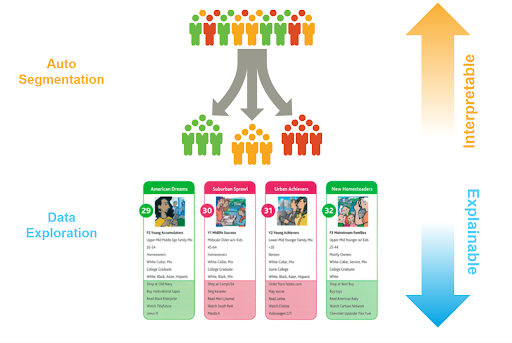
After identifying customer patterns and behaviors, you notice you have three main types of customer patterns:

  1. Frequent buyers that mainly buy career development courses
  2. Infrequent buyers that mainly buy personal development courses 
  3. Moderate buyers that buy a mix of both


(Image Source)

This insight helps you segment your customers into the following customer avatars:

  1. Career development customers 
  2. Personal development customers
  3. Career and personal development customers 

Later, you improve your marketing strategy to cater to these three customer avatars. You have three different kinds of social media campaigns, email newsletters, landing pages, websites, and paid ads. 

You can also repurpose content over time by launching a podcast or producing videos, for example. After this: This helps you produce the right content at the right time.

For your career development customers, you:

Focus your content on career advancement, job skills, and networking tips.

For your personal development customers, you:

Focus your content on personal growth, coping skills, and building self-confidence.

For your career and personal development customers, you:

Focus your content on how personal growth contributes to career growth.  

At this point, your planned content strategy is laser-focused and serves your three most common types of customers. 

Over time you keep an eye on behaviors and make adjustments when needed. You also keep an eye out for new customer avatars and buying habits.

Isn’t a CDP just a CRM?

CDPs and CRMs both work with customer data, but the two are pretty different. 

You may have wondered, “Why do I need a CDP? Isn’t a customer relationship management tool (CRM) the same thing?”

It’s actually not. 

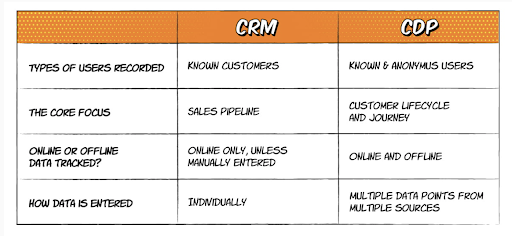
While CRMs contain data you already know (i.e., name, email, and zip code), CDPs collect data you wouldn’t know over a specific time. 

But there are more differences between the two tools. 

Here are some major differences between a CDP and a CRM.

1. Data capacity 

CRMs were intended to keep track of customer and prospect interactions to automate the process for sales teams. They’re great for sales and marketing teams that need to pull customer information quickly. 

CDPs are great at handling large amounts of data from various channels. 

2. Known data 

CRMs only contain known data — they won’t be able to pull anything on potential customers you’ve never met before. 

CDPs work with both known and unknown data making them more valuable than most martech tools. 

3. Storage information 

CRM data stores simple information into a few fields — almost like a flashcard. It includes basic customer information such as name and contact information. 

CDPs have detailed information about a customer’s buying patterns, online and offline activity, and behaviors.

4. Data format

CRMs can’t handle data in a free-flowing manner. The system can only recognize data if it’s formatted in a specific way (i.e., a CSV file). 

CDPs take information from several sources and act as a central hub for customer data. They can handle both simple and robust information while also making sense of complex data. This includes online and offline data and behaviors. 

5. Monitoring and engaging 

CRMs are helpful for monitoring and engaging with customers and prospects throughout all phases of the buyer’s journey. They work well at managing contact information and also have automated workflows and reports. Solopreneurs and small teams often use CRMs. 

CDPs are helpful for tracking all aspects of customer behavior on and offline. They pull information from various sources for customers you know and don’t know alike. They help you segment audiences and refine your messaging. Startups, mid-size, and large companies use CDPs.  

(Image source)

Which tool is better for customer experience — a CRM or a CDP?

While CRMs are helpful for engaging with customers at various parts of the customer journey, they’re still limited on information. 

The more detailed information a company has about their customers, the more insight they have as to what those customers crave.

First, you have to know what their pain points are. Then, you have to craft messages that align with customer needs. But a CRM can’t help you with that. It can help you manually look up customers and engage with them directly, but it doesn’t use machine learning or artificial intelligence to scour customer behaviors.  

That’s why, in the end, CDPs are better tools for enhancing the customer experience. 

Ready to transform your customer experience to the next level? 

Customer experience affects every aspect of success, making CDPs invaluable to a business. 

With a CDP, you’ll understand how your customer thinks, what they’re looking for, and what they like. You won’t need three tools, and multiple data set extraction tools. Instead, your CDP will pull information from various channels for you. 

Not only does this save you time, but it also helps you understand how to reach your customers in a profound way.

From knowing how to craft messages to building long-term relationships, a CDP is every business’s trusted tool for up-leveling the customer experience. 


Related: read more about location data for advertising and marketing.

Categories
Advertising & Marketing

How Web Design and UX Influence the Effectiveness of Programmatic Advertising

User experience (UX) and web design have become indispensable aspects of modern digital marketing. A website’s design and usability directly influence how users perceive a brand, interact with content, and make purchasing decisions. A cluttered or slow website can derail even the most well-targeted campaigns, leading to diminished engagement and lost conversions. Conversely, a site optimised for intuitive navigation and visual appeal can substantially enhance user trust and retention.

Programmatic advertising, with its reliance on automation and data-driven targeting, raises the stakes even higher. Unlike traditional advertising, programmatic campaigns must deliver highly personalised and relevant ads that seamlessly integrate into a user’s browsing experience. This requires a foundation of strong UX and web design to ensure the ads are engaging without being intrusive. Poorly designed platforms can disrupt the ad experience and alienate potential customers.

This article explores how UX and web design intersect with programmatic advertising to drive better engagement, stronger conversions, and higher returns on investment. It will examine key principles and strategies in the interest of highlighting the ways thoughtful design can amplify the success of programmatic campaigns.

Creating Seamless Ad Experiences

When users encounter advertisements, their first impressions are often shaped by how naturally the ads blend into the website’s environment. Intrusive or poorly placed ads can frustrate users and drive them away. Ideally, advertisements should feel like a harmonious part of the overall browsing experience. A carefully designed website ensures that ad placements are both strategic and unobtrusive, so users are encouraged to engage with them rather than bothered by their presence.

UX also plays a key role in determining the relevance of ads. Programmatic advertising can leverage user data, tailor content, and produce ads that align with individual interests. For instance, native ads mimic the style and format of the website. Because they integrate into the site seamlessly, their presence encourages trust and interaction. A well-thought-out UX ensures that ads appear in the right context and thus maximises their appeal and effectiveness.

Optimising for Speed and Performance

Few factors frustrate users more than a slow-loading website. Research consistently shows that delays of even a few seconds can lead to higher bounce rates and lower engagement. For programmatic advertising, these delays pose a double threat: not only does a slow site deter users, but it also diminishes the likelihood that ads will load quickly and display effectively. Businesses that prioritise performance create a smoother browsing experience that keeps users engaged and delivers ads at just the right time.

Web design directly influences site speed and performance. Optimising images, employing caching strategies, and using lightweight code can all accelerate load times, which benefit both the user experience and ad visibility. Moreover, responsive design ensures that content, including advertisements, adapts seamlessly to different devices and screen sizes.

Driving Engagement with Aesthetic Appeal

The visual appeal of a website can determine how long a user stays and whether they choose to interact with its content. Well-designed sites create an inviting atmosphere that draws users in, while cluttered or outdated layouts often have the opposite effect. A website that employs strong visual hierarchy can naturally guide the user’s attention to areas of interest, including strategically placed advertisements.

Consistency in design also plays a pivotal role in building trust with users. A cohesive colour palette, intuitive layout, and professional aesthetic reflect well on the brand and make users more receptive to embedded ads. Additionally, principles such as balance, contrast, and alignment guarantee that advertisements complement the overall design rather than disrupt it. These elements help foster a positive user experience that encourages interaction.

Enhancing Personalisation

Users today expect tailored experiences, and programmatic advertising thrives on personalisation. To achieve this, websites need designs that can accommodate dynamic, data-driven content. For instance, UX frameworks that adapt to user behaviour can display advertisements reflecting their preferences, purchasing history, or demographic profile. This alignment creates a more relevant and engaging experience for the user.

Personalisation is most effective when combined with seamless UX. A poorly designed interface that delivers targeted ads may still frustrate users if they struggle to navigate the site or don’t understand its functionality. With an intuitive and accessible website, businesses can amplify the effectiveness of personalised advertisements.

Tracking and Optimisation

Data collection is a cornerstone of programmatic advertising, and a well-designed website can streamline the process of gathering actionable insights. Businesses can monitor user behaviour and ad performance with greater precision by integrating analytics tools into the website’s framework. The information that they gain from such efforts allows marketers to adjust strategies and refine their campaigns for optimal results.

Moreover, UX plays a role in presenting data in actionable formats. Dashboards and reporting tools that are easy to navigate enable advertisers to make informed decisions quickly. Continuous optimisation also benefits from user feedback—features like surveys or heatmaps can reveal pain points and opportunities for improvement. Ultimately, a strong design foundation supports a cycle of tracking, learning, and adapting so that programmatic advertising remains effective in a dynamic environment.

As digital advertising continues to evolve, those who invest in strong design foundations will remain ahead of the competition. The synergy between UX, web design, and programmatic advertising is set to transform how businesses connect with their audiences—and to continue doing so well into the future. Companies can and should prioritise thoughtful design and user-centric experiences to maximise the impact of their campaigns.

Related: read more about location data for advertising and marketing.

Categories
Advertising & Marketing

The Role of Out-of-Home Advertising in Omnichannel Marketing Campaigns

Out-of-Home (OOH) advertising has stood the test of time as a critical marketing tool, evolving from traditional billboards and posters to interactive and data-driven displays. While digital marketing often dominates the conversation today, OOH advertising remains an essential component of omnichannel campaigns. Its ability to provide widespread visibility, drive engagement, and connect the physical and digital worlds makes it invaluable in creating a cohesive customer journey.

In this expanded article, we’ll explore the evolving role of OOH in omnichannel marketing, its unique benefits, and practical strategies to integrate it into your campaigns. By the end, you’ll have a comprehensive understanding of how OOH can enhance brand visibility, drive engagement, and contribute to measurable marketing outcomes.

1. What Is Out-of-Home Advertising in Omnichannel Marketing?

Out-of-Home advertising encompasses any marketing message displayed in public spaces, such as billboards, transit ads, posters, and connected TV ads.. Traditionally, these ads were static and focused on creating mass awareness. However, advancements in technology have transformed OOH into a dynamic medium that can integrate seamlessly with other marketing channels.

In an omnichannel strategy, OOH acts as a foundational element, delivering consistent messages across various touchpoints. It bridges the gap between physical and digital experiences, driving offline audiences toward online interactions or in-store visits. For example, a billboard advertising a sale might feature a QR code that leads directly to an ecommerce platform, blending traditional and digital marketing techniques.

2. Amplifying Brand Awareness Through Broad Reach

OOH advertising’s strength lies in its ability to reach broad audiences. Placed strategically in high-traffic areas such as highways, shopping districts, and transit hubs, OOH ensures visibility to a diverse demographic. This wide-scale exposure is particularly effective for building brand awareness and reinforcing messaging from digital campaigns.

Why OOH Works in Omnichannel Campaigns:

  • Unskippable Visibility: Unlike digital ads, OOH ads can’t be blocked or skipped, ensuring consistent exposure.
  • 24/7 Presence: OOH ads operate continuously, maximizing their impact over time.
  • Reinforcing Digital Messages: When paired with digital marketing, OOH ads strengthen brand recall by delivering consistent messaging across channels.

Example:

A streaming service promoting a new release could feature digital billboards in urban centers. These billboards showcase the same visuals and taglines as their social media ads, creating a cohesive message that resonates with audiences both online and offline.

3. Bridging the Gap Between Online and Offline Experiences

OOH advertising has evolved beyond static displays, thanks to advancements like QR codes, link shortening, geotargeting, and augmented reality (AR). When combined with a Unified Communication Platform, these technologies enable brands to create an interconnected ecosystem that bridges offline ads and online engagement.

How OOH Connects Channels:

  • QR Codes and Short URLs: Billboards with scannable QR codes lead users to product pages, promotional offers, or mobile apps, making it easy to transition from offline to online.
  • Location-Based Promotions: Brands can target audiences in specific areas, such as offering discounts to consumers near a store.
  • Social Media Integration: Interactive OOH campaigns often include hashtags or calls-to-action, encouraging consumers to share their experiences online.

“Interactive elements like AR and QR codes transform traditional OOH campaigns into gateways for deeper consumer engagement,” says Adrian Lee, Data Visualization Specialist and Statistical Analyst at Violin Plot. “They provide a seamless path from curiosity to action, making the customer journey more fluid and measurable.”


Example:

A luxury brand runs a digital OOH campaign in high-end shopping districts. The ads feature a QR code that unlocks an AR experience showcasing their latest collection, driving traffic to their ecommerce site and creating buzz on social media.

4. Leveraging Data-Driven Insights for Smarter Campaigns

Data has revolutionized OOH advertising, allowing marketers to optimize placement, timing, and messaging for maximum impact. With tools like geolocation tracking and audience analytics, brands can target specific demographics and measure the effectiveness of their campaigns.

Data-Driven Strategies for OOH:

  • Audience Targeting: Use demographic and behavioral data to select ad placements that align with your target audience.
  • Time-Sensitive Messaging: Tailor ads to display during specific times of day when the target audience is most active.
  • Tracking Conversions: Use unique URLs, promo codes, or geofencing to measure how many customers engage with the ad and take action.

Example:

A fitness brand uses geolocation data to place ads near gyms and parks, targeting health-conscious audiences. The ads include a promo code for discounted memberships, allowing the brand to track sign-ups generated from the campaign.

5. Enhancing Engagement Through Interactivity

Modern OOH campaigns often incorporate interactive elements to captivate audiences and encourage participation. Interactivity transforms passive viewers into active participants, creating memorable experiences that extend beyond the initial impression.

Examples of Interactive OOH Features:

  • AR and VR Experiences: Augmented and virtual reality elements allow users to engage with products in unique ways, such as visualizing furniture in their homes or trying on virtual outfits.
  • Gamified Campaigns: Brands can create challenges or scavenger hunts tied to OOH ads, incentivizing users to engage and share their experiences online. For example, OOH campaigns can tap into trends like Snapchat Planets, creating creative tie-ins to popular digital features that resonate with younger audiences.
  • Dynamic Content: Digital OOH screens can display real-time information, such as live social media feeds, countdowns, or weather-based promotions.

Example:

A travel agency runs an AR campaign where users can scan a billboard to explore virtual destinations. This immersive experience drives interest and directs users to book vacations through the agency’s app or website.

6. Measuring the ROI of OOH in Omnichannel Campaigns

For OOH to be an effective part of an omnichannel strategy, it’s essential to measure its impact. While traditional OOH relied on estimated impressions, modern tools provide precise data linking ad exposure to consumer actions. Accurate attribution is critical to understanding how OOH contributes to overall campaign performance, helping brands make informed decisions about budget allocation and strategy refinement.

Key Metrics to Monitor:

  • Foot Traffic: Measure the increase in store visits in areas where OOH ads are displayed, often using geofencing technology.
  • Website Traffic: Use QR codes or unique URLs to track how many users visit your site after seeing an OOH ad.
  • Social Media Engagement: Monitor hashtags, mentions, and shares related to the campaign to gauge online buzz.
  • Sales and Conversions: Analyze sales data in regions targeted by OOH ads to determine their impact on revenue.

“To truly maximize ROI, brands need to integrate data-driven tools that track both offline and online customer journeys,” says Alex Begum, Personal Injury Lawyer, (Villarreal & Begum, Texas Law Guns). “For example, pairing geolocation analytics with personalized QR codes allows businesses to identify precise user behaviors and adjust their strategies in real time.”

Example:

A food delivery app places transit ads promoting a discount for new users. The campaign features a unique code redeemable through the app, allowing the brand to track how many downloads and orders are generated from the ads.

7. Building Consistency Across Channels

Consistency is the cornerstone of successful omnichannel marketing. OOH advertising provides a visual anchor that reinforces brand messaging across all touchpoints, ensuring a cohesive experience for consumers.

Tips for Creating Consistent Campaigns:

  • Align Visuals and Messaging: Ensure OOH ads share the same themes, colors, and taglines as your digital and in-store campaigns.
  • Centralize Campaign Goals: Use OOH ads to highlight the primary objective of your campaign, such as driving app downloads or promoting a sale.
  • Personalize Where Possible: Leverage data to tailor OOH ads for specific locations or demographics, making them more relevant to the audience.

Example:

A beverage company runs a summer-themed campaign featuring billboards, Instagram ads, and in-store promotions. All touchpoints share the same imagery and hashtag, creating a unified and memorable campaign.

8. Real-World Success Stories of OOH in Omnichannel Campaigns

Case Study: Spotify Wrapped

Spotify’s annual “Wrapped” campaign leverages OOH ads to celebrate user data in a fun and shareable way. Billboard ads display quirky, data-driven insights, encouraging users to check their personalized Wrapped playlists. The campaign bridges physical ads with digital engagement, resulting in widespread social media buzz.

Case Study: IKEA’s AR Integration

IKEA combines OOH ads with its AR app, allowing users to scan billboards and visualize furniture in their homes. This seamless integration connects offline ads to in-app purchases, enhancing the customer journey and boosting conversions.

Conclusion

Out-of-Home advertising remains a vital component of omnichannel marketing campaigns. Its ability to capture attention in public spaces, drive engagement through interactive features, and connect with digital channels makes it a powerful tool for modern marketers. By leveraging data insights, ensuring consistent messaging, and incorporating interactivity, OOH advertising can amplify your brand’s reach and create a unified customer experience.

As technology continues to evolve, the potential for OOH in omnichannel campaigns will only grow. Brands that embrace its versatility and integration opportunities will be well-positioned to create impactful, memorable campaigns that resonate across all touchpoints.


Related: read more about location data for advertising and marketing.

Categories
Advertising & Marketing

Building Credibility: The Power of Public Relations in Shaping Your Brand

In today’s crowded marketplace, brand credibility isn’t just a bonus—it’s essential. A strong brand builds trust, attracts loyal customers, and stands out against competitors. At the heart of this trust-building process is public relations (PR). Through effective PR strategies, companies shape their image, solidify their reputation, and communicate their values to the world. Let’s explore how PR can elevate your brand’s credibility and provide the foundation for long-term success.

Why Credibility Matters in Today’s Market

Credibility is a cornerstone of growth for any business. Today’s consumers are savvy; they look for brands that deliver quality and demonstrate integrity and transparency. Credibility impacts how your audience perceives you, influencing whether they engage with your brand or look elsewhere. It strengthens customer loyalty, making them more likely to recommend your business to others.

The impact of credibility can be seen across industries. An essential factor in building this trust is understanding what is a PR team and how they contribute. A PR team shapes and communicates a brand’s narrative, focusing on consistent messaging that aligns with the company’s values. By managing public perception, they foster credibility that resonates with consumers and enhances the brand’s reputation in competitive markets.

Key PR Strategies for Building Credibility

Credibility isn’t created overnight or solely about a good product. Building trust with your audience requires deliberate PR strategies that communicate authenticity, consistency, and authority.

Authentic Storytelling

Storytelling is a powerful way to humanize your brand. Through genuine, relatable narratives, you can connect with your audience on a personal level. Whether it’s the story of how your company began, the challenges it has overcome, or the values it stands for, sharing your brand’s journey builds an emotional connection with your audience. For example, a small business might share how it was born out of a passion to solve a problem. Keeping the story authentic builds loyalty that reinforces your credibility.

Consistent Messaging

brand’s message should be like its backbone—strong and unified across every channel. Consistency reinforces your brand’s reliability. Consumers are more likely to trust you when they encounter the same values, tone, and promise on your website, social media, and customer communications. Inconsistent messaging can confuse or alienate customers, eroding credibility over time. PR can help ensure your brand’s message remains cohesive, amplifying trust in every interaction.

Media Relations

Building relationships with journalists and media outlets is vital. Media coverage lends legitimacy to your brand in the eyes of the public. A positive article in a respected publication can act as an endorsement, helping to boost your visibility and credibility. Media relations are about cultivating relationships over time, sharing press releases, and positioning your brand as a reliable source for industry insights.

Thought Leadership

Thought leadership involves positioning your brand as an authority in its field. You establish your brand as a go-to source for valuable information by sharing insights, conducting research, and offering expertise. Thought leadership builds credibility by showing that you understand your industry deeply and can guide others. This can be achieved through webinars, guest articles, speaking engagements, and expert commentary on industry trends.

Using Social Proof and Testimonials in PR

Social proof is a compelling form of validation. Testimonials, case studies, and customer reviews reassure potential customers by demonstrating that others have had positive experiences with your brand. PR can amplify these endorsements, incorporating them into campaigns and press releases to boost credibility. Working with influencers or industry experts is another way to enhance your brand’s credibility, especially if they genuinely align with your values and can share your product or service authentically.


A well-timed media feature highlighting positive customer stories and testimonials can create a ripple effect. It turns satisfied customers into advocates, helping others see your brand as trustworthy and dependable.

Crisis Management: Protecting and Rebuilding Brand Credibility

Even the best brands encounter crises. How your business handles a situation can make or break its reputation. Effective crisis management is a crucial part of PR, designed to protect and rebuild credibility if things go wrong. A well-prepared crisis response plan includes a clear communication strategy, a defined spokesperson, and transparency about the steps to resolve the issue.


Measuring PR’s Impact on Brand Credibility

It’s essential to measure the impact of your PR efforts to understand whether they are successfully building credibility. Metrics like media coverage, sentiment analysis, brand mentions, and customer loyalty are valuable indicators. Tools like Google Analytics and social media monitoring platforms help track mentions and analyze audience sentiment. Positive sentiment growth and increasing brand mentions indicate that your PR efforts are working.


For example, if a PR campaign leads to a surge in positive press coverage and online discussions about your brand, it’s a sign that your credibility is strengthening. Monitoring these metrics over time allows you to fine-tune your PR strategy and better understand what resonates with your audience.

Conclusion: Embracing PR as a Pathway to Trust

Credibility is the foundation of a lasting brand, and PR is one of the most effective tools for achieving it. Through authentic storytelling, consistent messaging, strong media relations, and proactive crisis management, PR can help shape how your brand is perceived. Investing in strategic PR efforts can establish a trustworthy brand that attracts customers and builds lasting connections. PR offers a pathway to enduring credibility and influence in a world where consumer trust is invaluable.


Related: read more about location data for advertising and marketing.